AI simulation surrogate models: geometric deep learning breaks the efficiency bottleneck
Ansys SimAI, Siemens Simcenter PhysicsAI and PhysicsX have pushed AI-accelerated simulation into the spotlight. We set out what surrogate models do, where they fit in design, and why they still cannot replace validated FEA or CFD.
In this article
In 2026, "using AI to speed up simulation" moved from a research topic to a space crowded with products and capital. Ansys restructured SimAI in its 2026 R1 release; Siemens, after acquiring Altair for about 10 billion dollars, folded PhysicsAI into Simcenter; and the UK start-up PhysicsX closed a 300-million-dollar Series C. These products share one name: the surrogate model — a model trained on pre-computed simulation data that then predicts results for new geometry in seconds, without calling the solver each time. Drawing on each vendor's own announcements and public reporting, this article sets out what they do, where in the design process they fit, and why they still cannot replace validated FEA or CFD. Sources were checked as of October 30, 2026; the performance and funding figures are vendor or press statements and have not been tested by CADFrontier.
1. What a surrogate model is
A traditional reduced-order model (ROM) usually requires the geometry to be parametrized by hand before a surrogate can be built. The newer approach is geometry-aware deep learning: it reads 3D geometry or a mesh directly and predicts physical fields across different topologies. Siemens' Simcenter PhysicsAI uses a transformer network optimized for geometry to predict stress, strain and other fields directly on mesh elements; Neural Concept says its Shape platform reads CAD directly with no preprocessing.
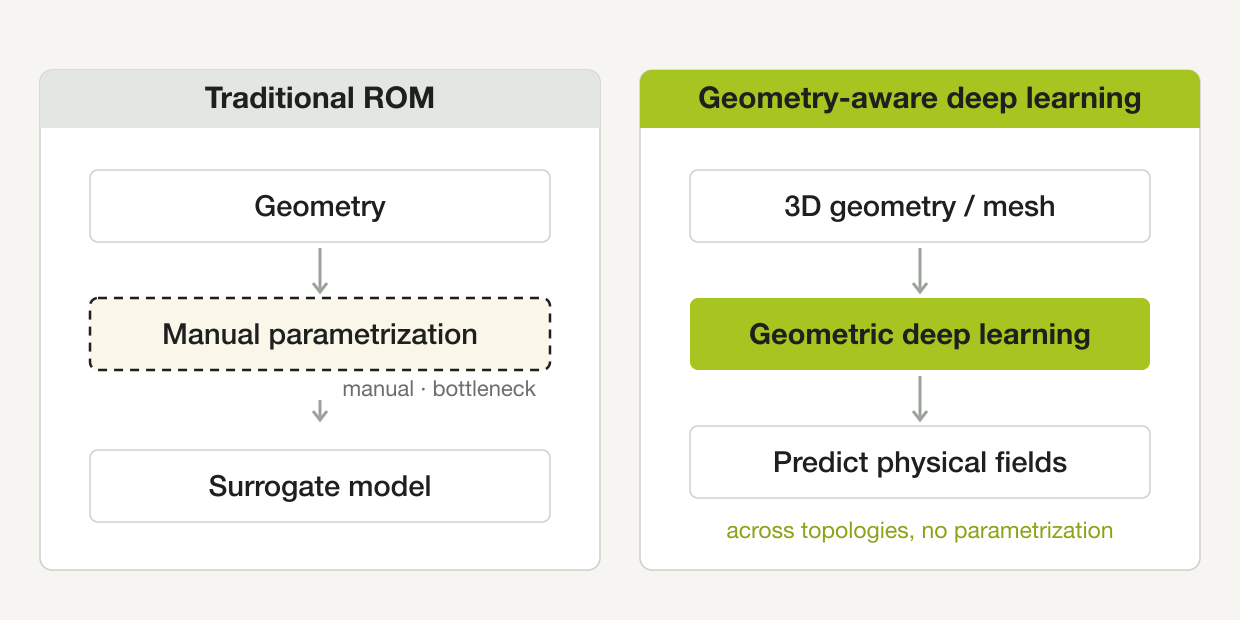
Figure 1: A traditional ROM needs manual parametrization first; geometry-aware deep learning reads geometry or a mesh directly and predicts across topologies. Drawn by CADFrontier.
Two things should be kept apart: predicting the performance of a geometry, and generating a new geometry, are different capabilities. The latter includes Ansys GeomAI, Simcenter PhysicsAI Generate and Neural Concept's design copilot. This article is about the former and only distinguishes the generative side.
2. What each vendor is doing
The following are vendors' public statements, untested.
- Ansys SimAI (now part of Synopsys): 2026 R1 splits it into two tiers — Premium as cloud SaaS, and Pro for teams that need data to stay local — and connects it through optiSLang into an end-to-end loop of generating training data, training, and use in optimization and design studies. The same release also introduced GeomAI for conceptual geometry exploration.
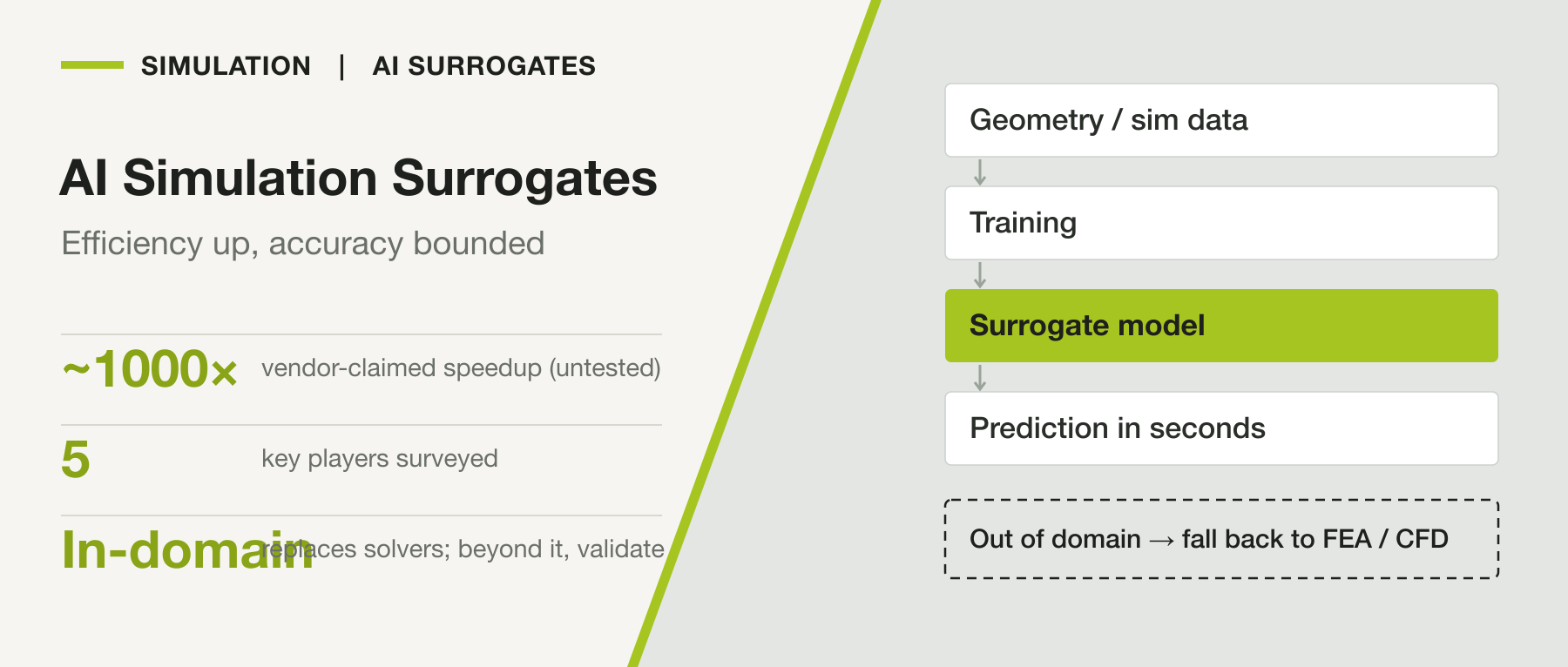
- Simcenter PhysicsAI (formerly Altair PhysicsAI): an add-on to STAR-CCM+, trained on existing simulation data, claimed to be about 1,000 times faster than conventional solving for design exploration; the 2026.1 release adds multi-GPU training, element-level prediction of stress and strain, and a "geometric similarity score."
- PhysicsX (UK start-up): closed a 300-million-dollar Series C at a valuation of roughly 2.4 billion dollars, led by Temasek with NVIDIA, Siemens and others participating; its direction is larger pre-trained "Large Physics Models."
- Neural Concept: its Shape platform trains geometry-aware surrogates directly on CAD, and it says it has more than 60 OEM customers (Airbus, ESA, Bosch, Subaru and others).
- Two further routes are worth distinguishing: Luminary Cloud runs a GPU-native "data factory" that links geometry variation, simulation, training and deployment; Monolith learns surrogates from physical test data rather than simulation results.
3. Where it fits in the design process
The most mature use of surrogate models today is early design exploration and optimization: sweeping thousands of variants within a fixed design family and taking slow solving off the critical path. The prerequisite is that you already have simulation or test data to train on — most products learn from simulation results, while tools like Monolith learn from physical test data, which is not the same thing. In other words, a surrogate moves the compute cost from "every evaluation" to "one training run"; what it saves is the time of repeated evaluation, not the validation itself.
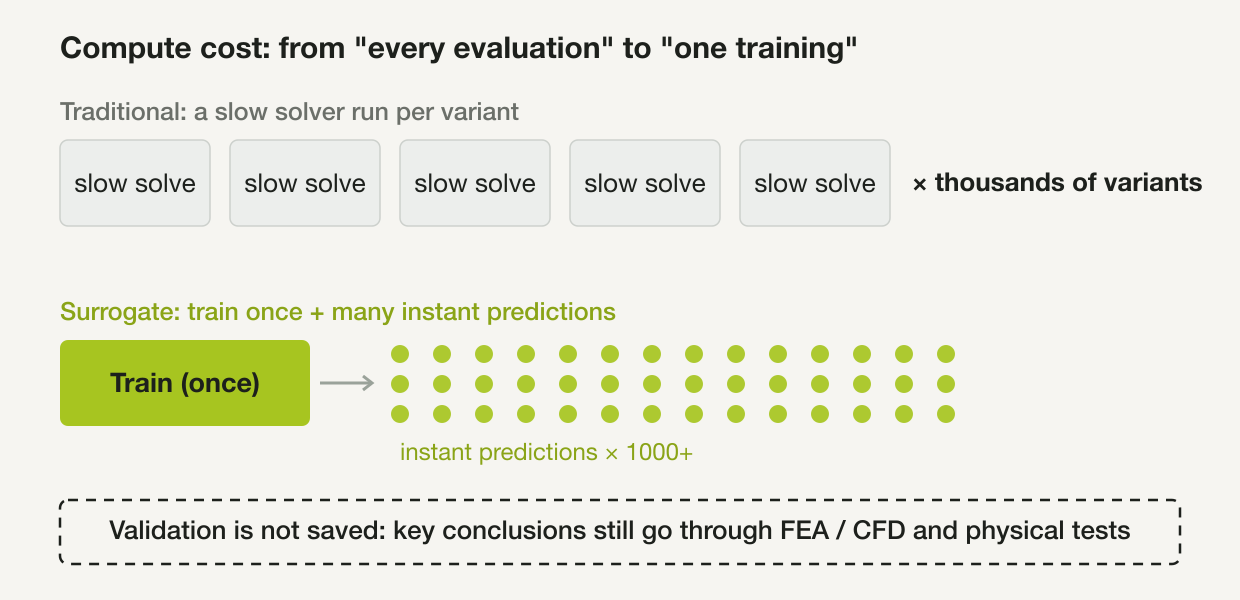
Figure 3: A surrogate shifts compute cost from "every evaluation" to "one training" — after training it runs thousands of instant predictions; validation itself is not saved. Drawn by CADFrontier.
4. Why it still cannot replace FEA or CFD
This is the section engineers should watch most closely.
The fundamental limit of a surrogate is that for inputs outside its training domain it still returns a prediction, and it often underestimates its own uncertainty — a confident hallucination. The consensus across academia and industry is that a surrogate can replace selected solver runs only within a validated range of designs and operating conditions; change the geometry family, the material model or the solver method and it usually needs to be retrained and revalidated. A fast prediction is not a validated CFD or FEA result, and neither is a physical test.
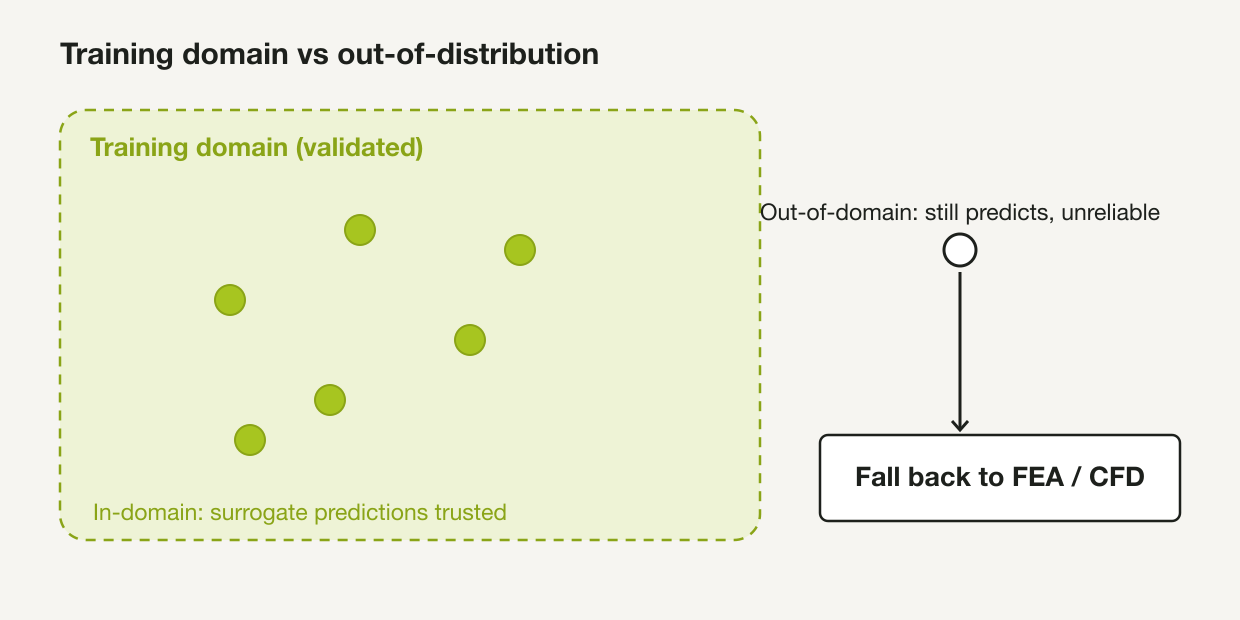
Figure 2: Within the validated training domain a surrogate can replace some solver runs; for out-of-distribution inputs it still returns a prediction, which should fall back to FEA/CFD. Drawn by CADFrontier.
Vendors are adding guardrails. In 2026.1 Siemens provides a "geometric similarity score" to indicate how close a new design is to the training set — essentially an uncertainty cue; the sensible practice is to fall back to the solver automatically for low-confidence or out-of-coverage cases. A more concrete constraint is standards: verification-and-validation (V&V) methods for machine-learning surrogates are not yet standardized, which keeps certification-sensitive sectors such as aerospace and civil engineering cautious. As one report put it, this kind of physics AI still "won't sign off your airbag" — the final judgment stays with the engineer.
5. A checklist for engineers
To evaluate a surrogate model, start with a few questions: does the training data cover my geometry family and operating conditions? Is there an indicator for out-of-distribution inputs, and a mechanism to fall back to the solver? Do the critical conclusions still go through high-fidelity checks and the necessary physical tests? Treat the surrogate as a tool for screening and acceleration, not as grounds for sign-off — it can rule out clearly unworkable options before a design is finalized, and what it saves is time, not that round of validation. (For why every step needs validation, see Making engineering agents reliable; for whether AI lands in real engineering, see the RWE-bench review.)
This article is an editorial analysis based on public material; the performance and funding figures are vendor or press statements and have not been independently verified. The illustration is a conceptual diagram drawn by CADFrontier.
Sources & further reading
- Synopsys: Launches Ansys 2026 R1 (SimAI Pro/Premium, optiSLang, GeomAI) ↗Source region: International
- Siemens blog: What's new in Simcenter PhysicsAI 2026.1 ↗Source region: International
- Siemens news: Simcenter PhysicsAI add-on ↗Source region: International
- Digital Engineering: PhysicsX raises $300M Series C ↗Source region: United Kingdom
- Neural Concept: AI simulation for engineering ↗Source region: Europe
- CoLab: Can AI replace FEA or CFD solvers? ↗Source region: International
- AI News: Siemens physics AI and human oversight ↗Source region: International
- CoLab: Best AI simulation tools for mechanical engineers (2026) ↗Source region: International