Mainstream CAD and AI: assistants, MCP and the wider ecosystem
A dated survey of mainstream mechanical CAD, official AI assistants, MCP interfaces, commercial add-ins, research datasets and open geometry kernels.
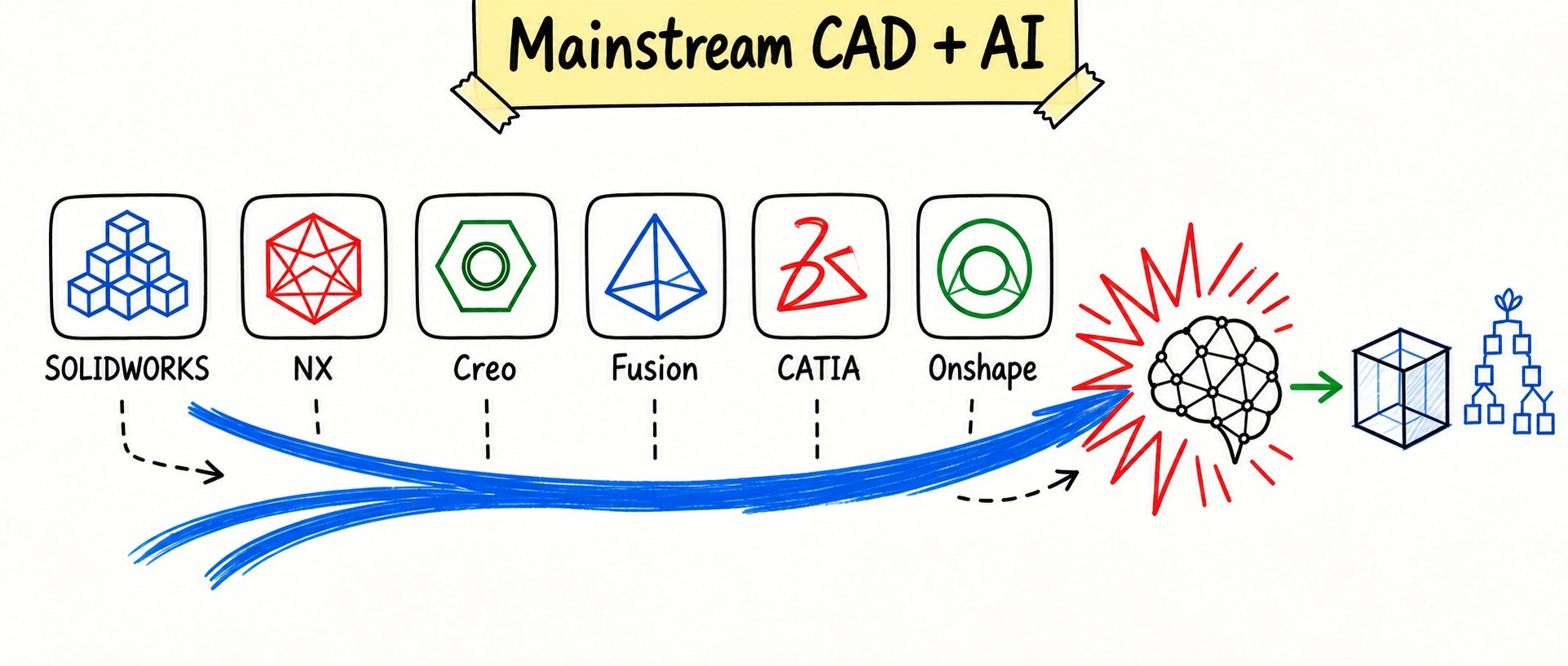
Originally published by AI驱动产品设计 on October 17, 2026. This is a dated survey, not a live inventory of every product or integration. Vendor statements describe the material reviewed; they are not results of installation or shop-floor testing by this author.
Discussions of AI in CAD often begin by comparing which assistant is better at conversation. I want to establish the landscape first.
This survey covers three questions: which mechanical CAD systems matter and how they are positioned; how their vendors are introducing AI; and how third-party and open-source projects extend them. That context helps locate later discussions of agents, MCP and text-to-CAD.
Market discussion uses attributable rankings or broad groupings rather than invented precise percentages. The original research covers public material available in October 2026.
1. Mainstream CAD: market context and engineering roles
For a mechanical engineer, a mainstream system usually supports parts, assemblies and drawings, and fits an organization's engineering processes. The scope here is Dassault SOLIDWORKS and CATIA; Siemens NX and Solid Edge; PTC Creo and Onshape; and Autodesk Fusion and Inventor. AutoCAD remains important for 2D work and its ecosystem, but this comparison focuses on 3D mechanical CAD. Chinese 2D and building-structure products are not treated as equivalent MCAD systems.
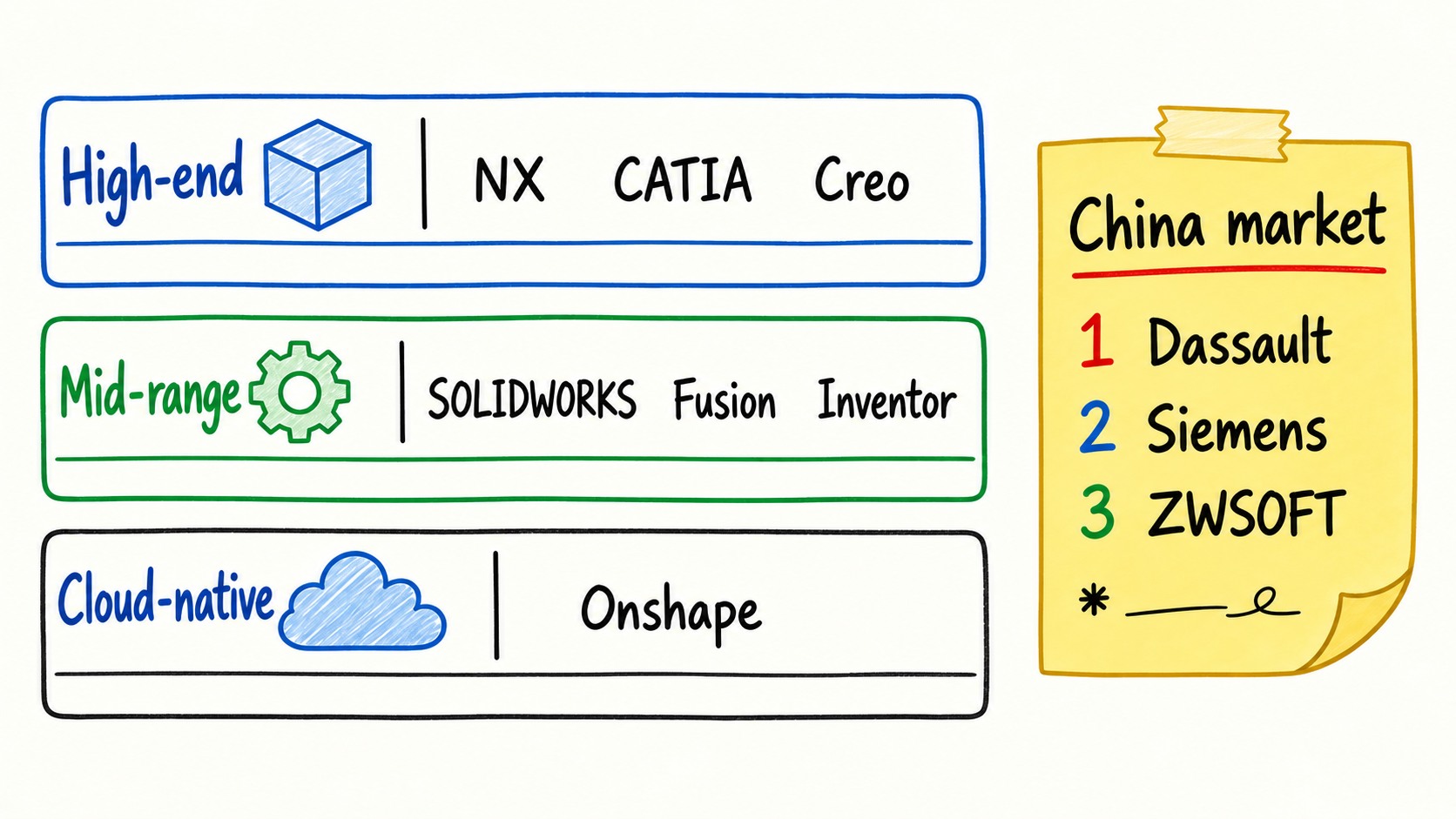
Illustration. Conceptual product groupings, not exact market shares. The Chinese-market annotation refers to IDC's overall 2025 CAD market, not a mechanical-3D-only ranking.
1.1 Global: broad groupings are easier to cite than precise shares
Detailed CIMdata market shares are generally in paid reports. One publicly discussed view comes from commentary on the 2025 CIMdata Industry Forum, including Beyond PLM's account: SOLIDWORKS was prominent in MCAD revenue comparisons, followed in that discussion by Autodesk products including Inventor and AutoCAD; Solid Edge and Creo retained established positions while appearing lower in that particular revenue view.
The broader PLM discussion often groups Siemens, Dassault, Autodesk and PTC together. PLM revenue is not installed seats for an individual 3D CAD application, so those measures should not be substituted for one another.
1.2 China: distinguish overall CAD from 3D CAD
August 2026 media coverage of IDC's China Design and R&D Industrial Software: CAD Market Shares, 2025 reported:
- Dassault Systèmes, Siemens and ZWSOFT were the top three in China's overall 2025 CAD market.
- Dassault, Siemens, PTC and ZWSOFT were among the leading 3D CAD suppliers; this is a different scope from the overall top-three statement.
- Commentary described Chinese suppliers gaining share and competition moving from license price toward measurable efficiency, connected data and AI.
Those claims are attributed to coverage of the report, not to independent access to its complete underlying data. The original article also offers a qualitative engineering observation: CATIA/NX are familiar in automotive and aerospace supply chains; SOLIDWORKS in smaller mechanical-design and tooling organizations; Fusion in rapid-iteration teams; and Creo in established discrete manufacturing. These are broad contextual observations, not measured sector shares.
1.3 Engineering characteristics
- SOLIDWORKS — Broad position in this survey: Established midrange MCAD; widely recognized among smaller engineering teams; Engineering characteristics: Extensive training and add-ins; Windows deployment and licensing; mature assemblies and drawings
- Siemens NX — Broad position in this survey: High-end complex-product workflows; Engineering characteristics: Complex surfaces and large assemblies; links to Teamcenter and manufacturing; substantial learning and licensing commitments
- PTC Creo — Broad position in this survey: Established parametric mechanical design; Engineering characteristics: Parametric modeling and MBD; Windchill integration; Creo+ cloud subscription direction
- Autodesk Fusion — Broad position in this survey: Integrated cloud-oriented design and manufacture; Engineering characteristics: CAD, CAM and electronics; collaboration; active public automation interfaces
- CATIA — Broad position in this survey: High-end product definition; Engineering characteristics: Complex surfaces and products, with 3DEXPERIENCE workflows
- Inventor — Broad position in this survey: Autodesk's desktop mechanical-design line; Engineering characteristics: Connections to AutoCAD and Vault; established enterprise workflows
- Solid Edge — Broad position in this survey: Siemens' midrange offering; Engineering characteristics: Synchronous technology and data exchange with the wider Siemens ecosystem
- Onshape — Broad position in this survey: PTC's cloud-native CAD; Engineering characteristics: Browser collaboration, version branching and programmable FeatureScript features
2. How vendors are introducing AI
Public offerings fall into different categories: in-product copilots or companions; AI within drawing, constraint or command workflows; cloud services with subscription or token consumption; and interfaces allowing an external agent to act through MCP or APIs. They are related, but they do different jobs.
2.1 Siemens: Design Copilot and manufacturing assistance
In July 2025, Siemens introduced Design Copilot NX in NX/NX X, emphasizing natural-language access to documentation, recommended practices and faster learning. That is assistance within the design environment, rather than proof that an arbitrary external agent can autonomously modify a complete feature tree. Designcenter X NX Copilot continues contextual guidance, while manufacturing has offerings such as NX CAM Copilot. Capabilities and availability should be read against the relevant release material.
Official Siemens product context and illustrations.
2.2 Dassault / SOLIDWORKS: AURA, LEO and Virtual Companions
SOLIDWORKS Design promotes AI Virtual Companions, including AURA for connecting users with knowledge and LEO for engineering construction and validation, alongside Cloud Services and 3DEXPERIENCE. Public examples include command prediction, assembly assistance and faster drawing annotation. AI usage follows a token-consumption model.
CATIA and the wider 3DEXPERIENCE platform use their own industrial-AI and companion positioning; that should not be flattened into one desktop SOLIDWORKS feature set. Nor does an in-product companion establish an official MCP through which any external agent can edit the model. The original survey found community COM bridges relevant to that external-agent route.
Official SOLIDWORKS Virtual Companions overview.
2.3 Autodesk Fusion: an assistant and official MCP interfaces
Fusion documents both directions. Autodesk Assistant provides in-product guidance, with geometry-editing demonstrations and Tech Preview capabilities. Workflow tools include Automated Drawings and Sketch AutoConstrain. The official Fusion MCP supports a live local session, scripts, documentation and inspection, while Fusion Data MCP addresses cloud data. For teams connecting an external agent, the public Fusion material describes a relatively explicit development and troubleshooting route.
Official Fusion MCP workflow and illustrations.
2.4 PTC: Creo AI Assistant and Onshape FeatureScript MCP
Creo 13's 2026 announcements introduce Creo AI Assistant for conversational guidance, recommended practices and troubleshooting. PTC's help separates Creo Advise, available to registered users for help and support knowledge, from Creo Assist, which requires an Advanced AI license and can use design context. Beta announcements about reading a 3D model must be distinguished from generally available functionality.
Onshape has a Labs-level FeatureScript MCP route focused on generating reusable feature code from text. That is not an automatic approval process for arbitrary assemblies.
Creo Assistant capability and license overview, and Onshape's FeatureScript MCP explanation.
2.5 Summary of the original survey
- Siemens NX — Public official AI form: Design Copilot / Designcenter Copilot; manufacturing copilots; External-agent route identified: NX Open remains a key automation interface; this survey did not identify an equivalent delivered official modeling MCP
- SOLIDWORKS — Public official AI form: AURA/LEO and other companions; token usage; External-agent route identified: Community COM/MCP bridges are distinct from an official Dassault MCP
- Fusion — Public official AI form: Assistant, workflow AI and official MCP; External-agent route identified: An explicitly documented official route
- Creo — Public official AI form: Assistant with Advise/Assist capability and licensing levels; External-agent route identified: Third-party CREOSON; no delivered official modeling MCP established by the material reviewed
- Onshape — Public official AI form: AI Advisor and FeatureScript MCP in Labs; External-agent route identified: Official experimental route focused on feature code
Failure to identify an interface in this survey is not proof that none exists. Product availability also depends on software version, deployment, entitlement and release stage.
3. What third parties and open source add
Official AI is usually tied to a product's release, licensing and support arrangements. Actual reliability still needs to be tested on the task. Community and commercial tools explore additional interfaces and workflows, often moving on different schedules.
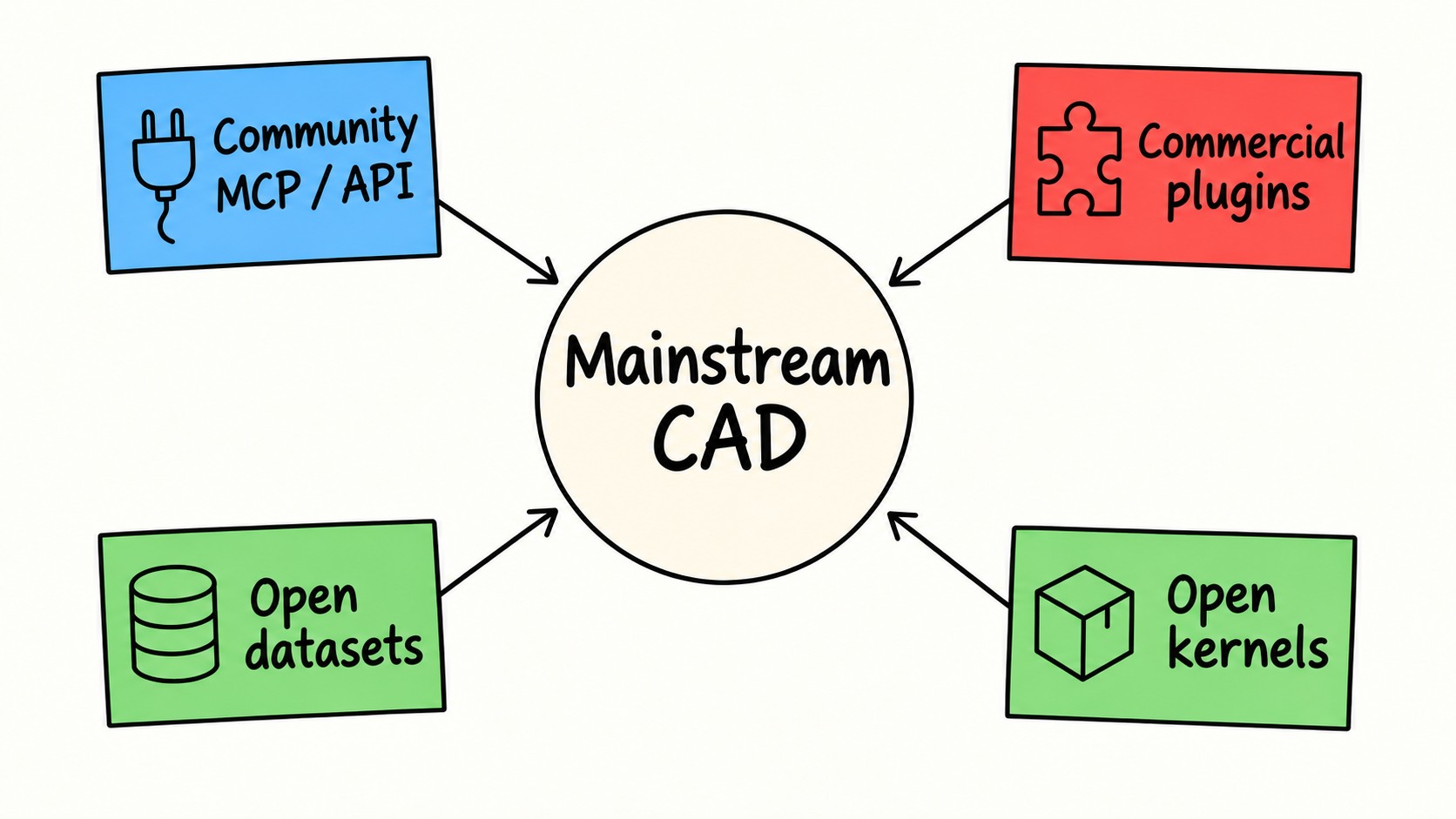
Illustration. AI-generated conceptual map of community MCP interfaces, commercial add-ins, research datasets and geometry kernels.
3.1 Letting external agents operate CAD
A direct approach wraps an existing automation interface in MCP so an external client can call tools and inspect results.
- SOLIDWORKS: projects such as SolidworksMCP wrap COM-based automation around an active CAD session.
- NX: community projects including NX_MCP and nx-auto-mcp expose operations through NX Open or plug-in layers.
- Creo: CREOSON has an established JSON/HTTP automation interface; its 4.x work adds an MCP endpoint and skills in beta.
- FreeCAD: freecad-mcp is one identifiable community route.
These supply external-agent entry points. Fusion and Onshape had especially explicit official MCP material among the sources collected for the original survey. A bridge still requires a usable host installation, the right license, sufficient tool coverage and stable references to geometry.
3.2 Modeling, drawings, checks and BOMs
Commercial third parties package language-model assistance into engineering workflows:
- CADABRA, a SOLIDWORKS add-in, describes natural-language native-feature operations, drawings and BOMs using company templates. Higher subscription tiers add DFM findings for draft, minimum radius, wall thickness and undercuts, plus cost estimates. Its FAQ distinguishes findings from a universal score.
- MecAgent describes a desktop agent connected to CAD sessions for parts, assembly operations and macros, with background drawing and drawing-to-CAD work. The original survey emphasized SOLIDWORKS and noted Inventor in its public material; supported products must be checked against the relevant release.
- Draft AI describes drawing dimensions, GD&T and ASME/ISO-oriented checks, with additional SOLIDWORKS workflows. Its stated dimension-extraction accuracy of roughly 90%–95% on clear drawings is a vendor claim, accompanied by a recommendation for final human verification.
My interpretation is that SOLIDWORKS attracts considerable third-party attention because of its installed ecosystem and mature automation interfaces. This is an ecosystem observation, not a measured market-share calculation.
3.3 Datasets and benchmarks
Research datasets supply training material and evaluation settings, rather than direct replacements for a commercial CAD installation:
- ABC Dataset: roughly one million CAD models, including STEP and explicitly parameterized surfaces, for geometric deep-learning research.
- DeepCAD / Fusion 360 Gallery: construction-sequence data, including sketch-and-extrude workflows.
- Text2CAD: DFKI-associated research adding approximately 660,000 text descriptions to about 170,000 DeepCAD models. Its CC BY-NC-SA 4.0 dataset license restricts commercial reuse.
- Text2CAD-Bench: graded text-to-CAD evaluation, with reference STEP geometry withheld to reduce contamination.
These can support research on text-conditioned construction sequences and offer comparison settings. Their task distributions and licenses still need to be checked before using them to train a product or claim engineering capability.
3.4 Geometry kernels: another underlying option
The USD BRep 1.0.0 changelog is dated October 8, 2026. NVIDIA's repository provides NURBS-based boundary-representation libraries, including SMLib-related functionality, C++/Python interfaces and OpenUSD import/export, under Apache 2.0. GitHub's release display can show October 9 depending on timestamp/timezone.
This does not automatically add an AI feature to an existing commercial CAD package. It adds an open geometry foundation alongside options such as Open CASCADE, with its own integration work, supported geometry and known issues.
3.5 Comparison and limits
- External agents through community MCP, COM, NX Open or CREOSON — Relevant environment: SOLIDWORKS, NX, Creo, FreeCAD; Survey assessment: Task-dependent; CREOSON MCP remained beta; Main issues to evaluate: Maintenance, local licenses, active sessions, unstable face selection
- Commercial modeling, drawing, DFM and BOM workflows — Relevant environment: Especially SOLIDWORKS; some Inventor coverage in the original material; Survey assessment: Rapid iteration; validate individual tasks; Main issues to evaluate: Subscription cost, data handling, supplier continuity
- Drawing interpretation and standards-related checks — Relevant environment: General drawings and CAD add-ins; Survey assessment: Useful assistance, not final engineering release; Main issues to evaluate: Recognition errors and critical dimensions
- Datasets and benchmarks — Relevant environment: Indirectly relevant across CAD systems; Survey assessment: Research settings; Main issues to evaluate: Noncommercial licenses and gaps to complex production parts
- Open kernels such as USD BRep / SMLib — Relevant environment: Not one commercial host application; Survey assessment: Newly public 1.0 in the original survey; Main issues to evaluate: Known issues and, at that time, no external code contributions accepted
Build123d or CadQuery with MCP can be useful for a loop of agent → modeling → inspection. Their code-driven construction is not the persistent native feature history of NX, SOLIDWORKS or Creo. A team's revision, drawing and release workflow must account for that distinction. GitHub stars and demonstration videos establish interest, not workshop readiness.
4. What the map helps distinguish
- Market position: global commentary and broad product groupings differ from exact paid-report shares. In China, the cited overall-CAD ranking of Dassault, Siemens and ZWSOFT must not be recast as a mechanical-3D-only ranking.
- Official AI: an in-product copilot, a workflow automation feature and an external-agent MCP serve different purposes. Fusion MCP and Onshape FeatureScript MCP were particularly explicit official routes in the collected material.
- The surrounding ecosystem: community interfaces add access; commercial add-ins package workflows; datasets and benchmarks support research; geometry kernels provide a foundation. None, by itself, proves an autonomous engineering release process.
Related: feature history and the practical effect of AI in CAD.
Illustrations are conceptual, not screenshots from a new product test. The English edition uses separately localized English illustrations with matching captions. Official product illustrations are linked at their sources.
Sources & further reading
- Observations from the CIMdata Industry Forum ↗
- China News coverage of IDC China CAD market shares, 2025 ↗Source region: Mainland China
- Siemens NX Summer 2025 and Design Copilot ↗Source region: International
- SOLIDWORKS AI Virtual Companions ↗Source region: International
- Build Your Own Fusion Add-ins with the Fusion MCP ↗Source region: International
- Creo AI Assistant official help ↗Source region: International
- Onshape FeatureScript MCP ↗Source region: International
- SolidworksMCP community repository ↗
- NX_MCP community repository ↗
- CREOSON project and 4.0 beta ↗
- FreeCAD MCP community repository ↗
- CADABRA official FAQ ↗
- MecAgent product overview ↗
- Draft AI product and accuracy claims ↗
- ABC Dataset ↗
- DeepCAD research paper ↗
- Text2CAD dataset and license ↗
- Text2CAD-Bench dataset and benchmark ↗
- NVIDIA USD BRep repository and license ↗
- NVIDIA USD BRep 1.0 release record ↗