Siemens industrial software: the full-lifecycle portfolio from requirements to production
Based on Siemens' product pages, we set out the software in Siemens Xcelerator for product development and manufacturing — from requirements, design and simulation to manufacturing planning, production execution and operations data — and the strengths and costs of the portfolio.
In this article
The major international vendors of industrial software include Dassault Systèmes, Siemens, Autodesk and PTC. Siemens is one of those covering the most stages, and its PLM software Teamcenter was named a Leader in the 2026 Gartner Magic Quadrant [1]. At group level, industrial software is a focus of Siemens' ONE Tech Company program, and the acquisition of the simulation company Altair in 2025 for about USD 10 billion was one step in it [14]. According to Siemens' annual report for fiscal 2025 (ended September 30, 2025), group revenue was €78.9 billion, and the software business within Digital Industries had revenue of €6.174 billion [15].
Siemens groups its software for requirements, design, simulation, manufacturing planning, production execution and operational data analysis in the Siemens Xcelerator portfolio. Using the product pages on Siemens' official website, this article sets out how the portfolio divides the work across the product lifecycle. Sources were checked as of October 28, 2026; the product positioning quoted is Siemens' own.
1. Overall framework
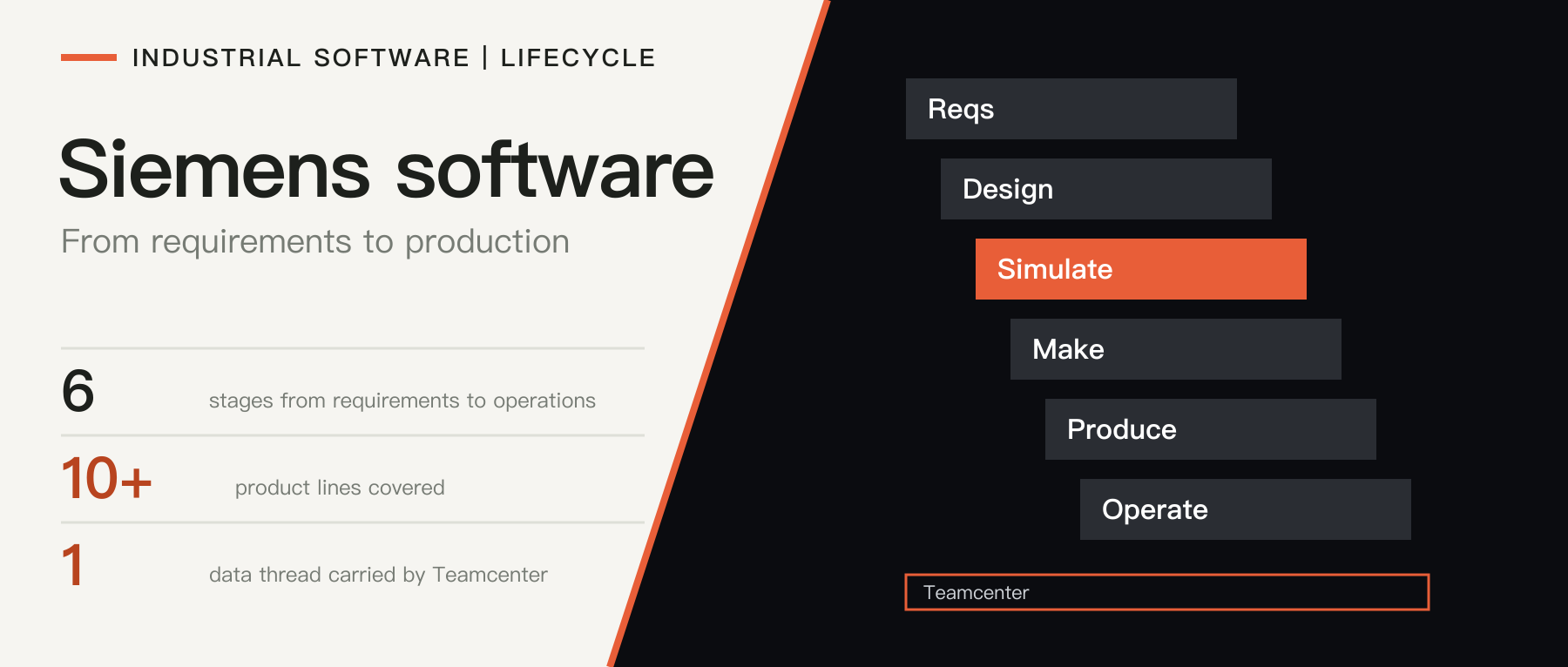
The Teamcenter page divides the product lifecycle into three stages: Plan, setting the strategic direction and product definition; Develop, designing and documenting the multi-discipline product; and Deliver, using the digital thread to connect product development with manufacturing, service and suppliers [1]. The software in each stage below is organized around this thread.
Siemens Xcelerator itself is a wider platform: Siemens says it brings together more than 1,700 solutions from Siemens and certified partners, with more than 400 certified sellers, across five domains — industry, buildings, electrification, grids and transportation [13]. This article covers only the parts directly related to product development and manufacturing.
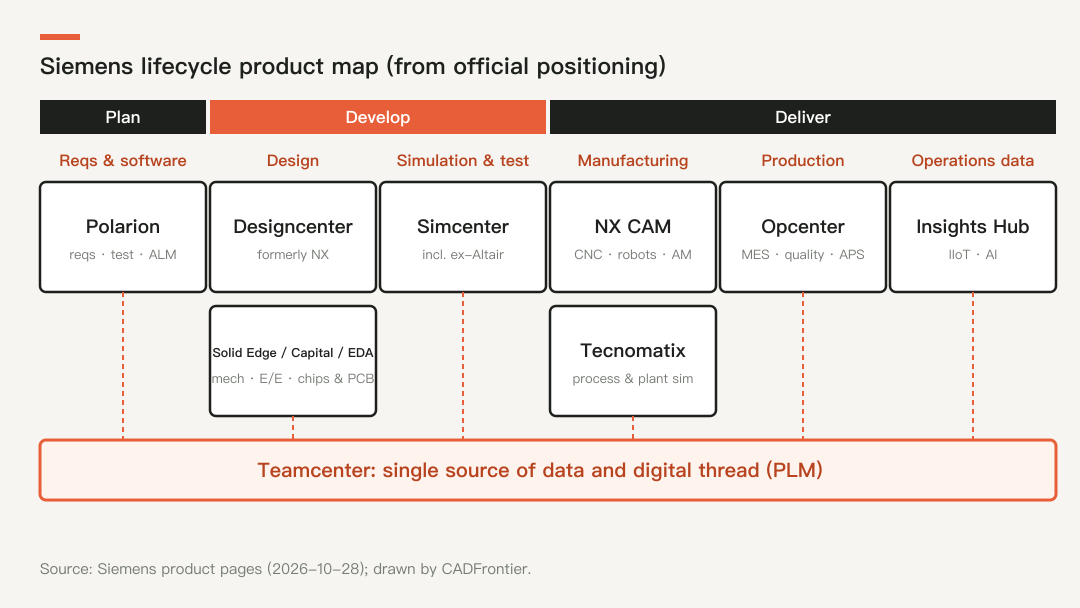
Figure 1: Siemens' lifecycle product map, arranged from the official positioning, with Teamcenter running through every stage. Drawn by CADFrontier.
2. Definition and design
Polarion is application lifecycle management (ALM) software for requirements, software development and test management, with an emphasis on traceability for compliance-heavy development [2]. Siemens sums up its capabilities in three points: traceability with automatic change control of every requirement; collaboration controlled by permissions and workflows; and reuse of requirements, code and tests across projects and product lines. It is offered as on-premise Polarion ALM and cloud-based Polarion X, with more than 200 extensions for integration with other tools [2].
Mechanical design is handled by Designcenter, formerly NX, renamed from June 2026 [4]. Siemens stresses that it is built on the Parasolid kernel, scales from start-ups to global OEMs, and gives on-demand access to capabilities through token licensing [3]. Besides mechanical design, the suite includes electrical design, automation design, industry workflows, immersive engineering and AI tools [3]. Designcenter Solid Edge covers mechanical and electrical design, simulation, CAM, technical publications and data management, and the site already shows its 2027 release [5]. As we understand it, Designcenter serves the full range from start-ups to large OEMs, while Solid Edge suits users who care more about ease of adoption.
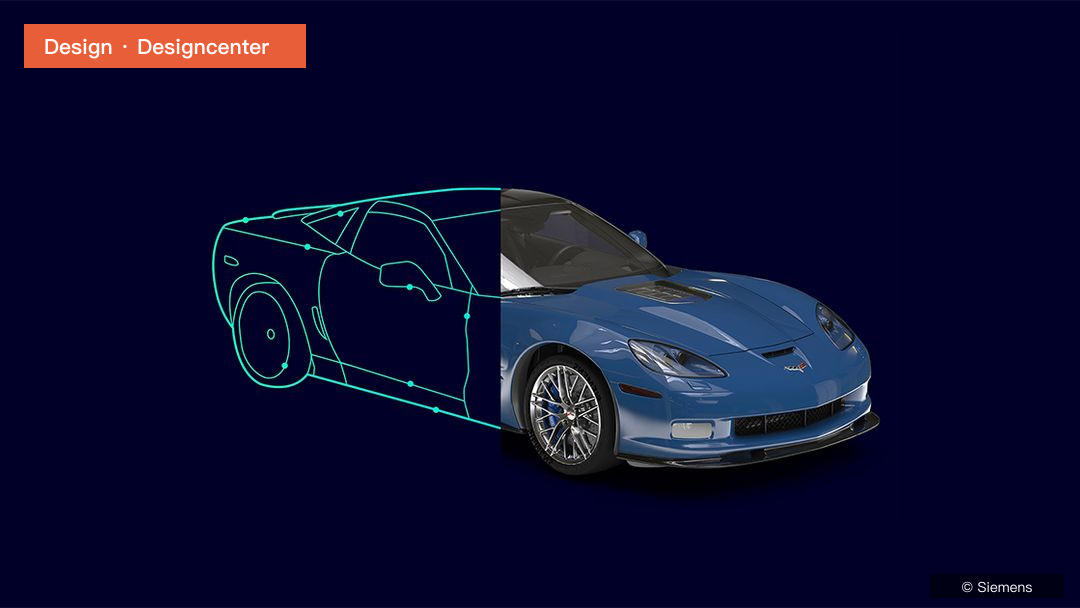
Figure 2: Image from the Designcenter page, with a wireframe on the left and a rendering on the right, illustrating the move from design model to digital twin. Source: Siemens website, © Siemens; label added by CADFrontier.
On the electrical side, Capital covers E/E system architecture, wire harness design and AUTOSAR embedded software [6], and Siemens EDA provides chip and circuit-board design tools [7]. Capital's electrical area combines schematic design, 3D harness routing and model-based validation in one ECAD–MCAD workflow, while its systems area optimizes E/E architectures against targets such as cost, weight and bandwidth [6]. The mechanical, electrical and software lines thus run in parallel within one portfolio.
3. Simulation and test
Simcenter covers mechanical and manufacturing simulation, fluids and thermal, systems simulation, multidisciplinary design analysis and optimization (MDAO), and physical testing [8]. Its June 2026 release includes former Altair products for the first time [8]. Siemens stresses a digital thread connecting CAD, CAE and PLM, so that simulation models can be traced to product data [8]. According to the site, mechanical simulation predicts multi-discipline mechanical performance, fluid simulation handles multiphysics CFD, systems simulation optimizes system performance early in design, and physical testing supports test-based engineering [8]. Keeping simulation and test in one portfolio means test data can be used to correlate simulation models.
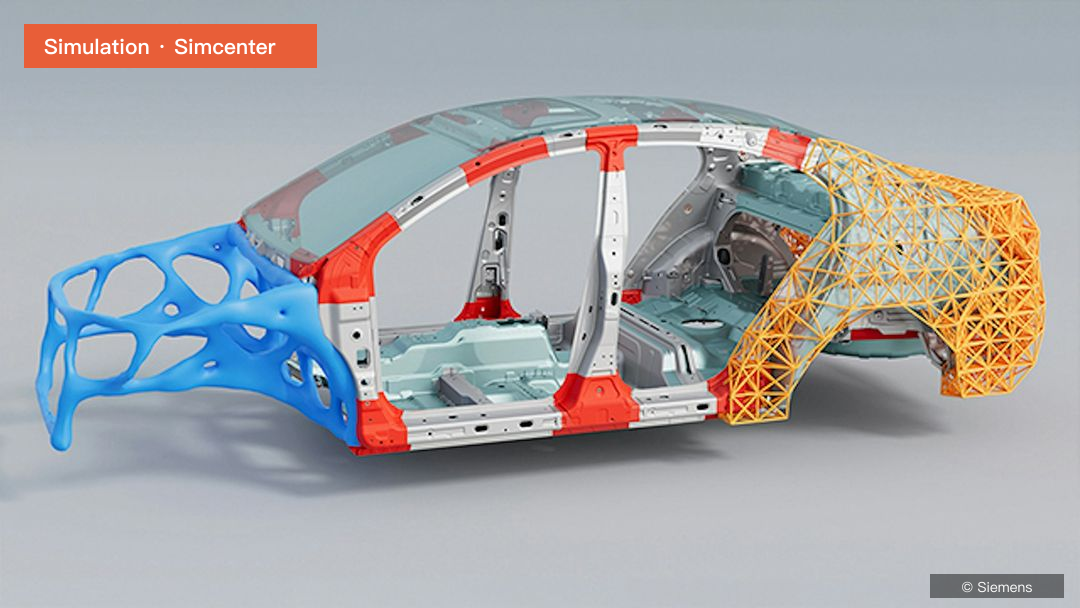
Figure 3: Image from the Simcenter page showing multidisciplinary simulation models of a vehicle body structure, with topology-optimized geometry in blue. Source: Siemens website, © Siemens; label added by CADFrontier.
4. Data and process
Teamcenter is the product lifecycle management (PLM) system; Siemens positions it as connecting people and processes throughout the product lifecycle with a single source of data, and offers Teamcenter AI and Teamcenter Copilot [1]. In this portfolio, Teamcenter is where design, simulation and manufacturing data meet. Siemens stresses using the digital twin to connect processes for designs, systems, software, simulation and visualization, resolving problems before they become real; the same page also cites assessments by Forrester and ABI Research [1].
5. Manufacturing
Part manufacturing is handled by NX for manufacturing: CNC programming, robot programming, additive manufacturing, mold and fixture design, and a closed-loop quality solution connecting CMM inspection programming, execution and measured-data analysis [9]. The CAM capabilities Siemens mentions include advanced toolpath technologies and G-code-driven simulation; the cloud version is NX X Manufacturing [9].
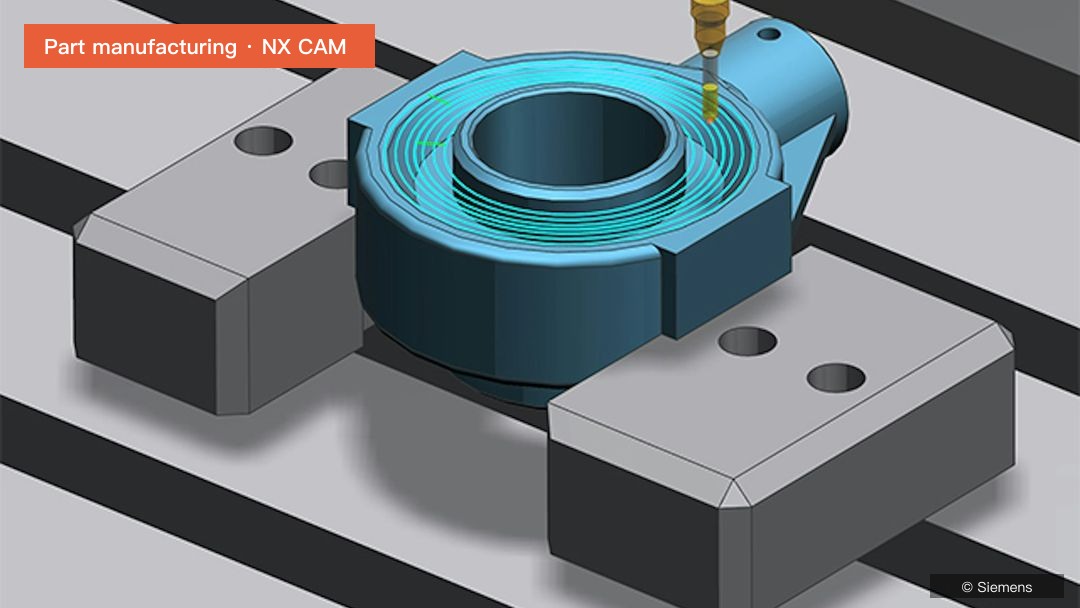
Figure 4: Image from the NX X Manufacturing page showing a part in a fixture with a spiral milling toolpath. Source: Siemens website, © Siemens; label added by CADFrontier.
Manufacturing planning is handled by Tecnomatix: Process Simulate validates processes in a 3D environment, Plant Simulation simulates material flow, throughput and resource utilization of production systems, and there are process-planning tools such as Teamcenter Manufacturing Planning and Teamcenter Easy Plan, as well as electronics assembly programming tools [10]. Siemens stresses building a digital twin of manufacturing processes, including robots, automation, material handling and people, to evaluate process options before production [10].
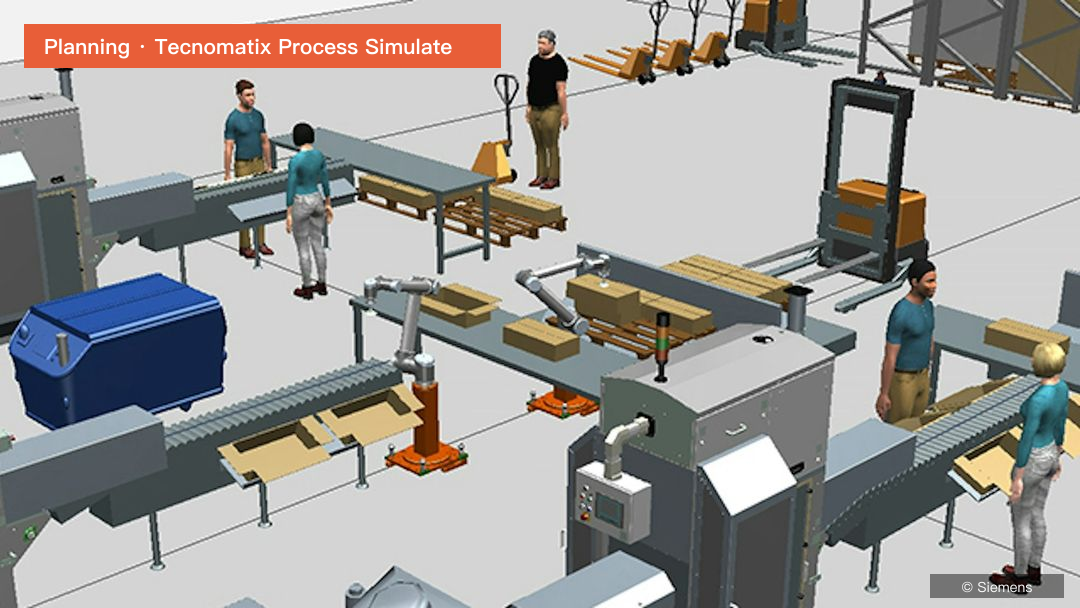
Figure 5: Image from the Tecnomatix Process Simulate page: a 3D process simulation model with robots, AGVs, conveyors and people. Source: Siemens website, © Siemens; label added by CADFrontier.
6. Production and operations
Opcenter is a manufacturing operations management (MOM) portfolio covering manufacturing execution (MES), quality management, production planning and scheduling, and manufacturing intelligence [11]. Siemens defines MOM as the real-time software layer linking PLM to automation, and stresses comparing as-planned and as-is data for closed-loop improvement [11]. Products include Opcenter APS for planning and scheduling and Opcenter Execution for manufacturing execution [11].
Insights Hub is an industrial IoT and AI analytics platform that uses equipment and process data to improve availability, quality, performance and energy use, and offers a Production Copilot; users can define their own skills in Copilot Studio to capture repeatable operational knowledge [12]. For maintenance, the site describes combining predictive, preventive and corrective strategies according to asset criticality [12].
7. Discussion
On Siemens' own description, the portfolio's distinguishing features are its breadth and the data continuity between stages that one vendor provides. The keywords the site keeps using are digital twin, digital thread and closed loop: design data flows into simulation and manufacturing, and measured and production data flow back to design and planning.
We consider the costs equally clear: the portfolio is large, with many products, so deployment, integration and learning costs are high; for most small and mid-sized companies a more realistic approach is to start with a single stage, such as design or PLM, and extend as needed. For example, a company that only machines mechanical parts may need just Designcenter and NX CAM, while automotive and aerospace companies are the ones that use the full chain from Polarion and Capital to Opcenter. The cloud versions of the products, such as Designcenter X, NX X Manufacturing, Polarion X and Capital X, lower the entry threshold [2][3][6][9]. On AI, products such as Teamcenter and Insights Hub each have a Copilot [1][12].
Overall, Siemens' products cover every stage from requirements to operations, with the data thread carried by Teamcenter at the core. Companies evaluating them should start from the stage they are in and verify the actual scope of integration between products.
Sources & further reading
- Siemens: Teamcenter PLM ↗Source region: International
- Siemens: Polarion ALM ↗Source region: International
- Siemens: Designcenter ↗Source region: International
- Siemens Designcenter blog: Designcenter | A new name for the future of engineering ↗Source region: International
- Siemens: Designcenter Solid Edge ↗Source region: International
- Siemens: Capital E/E systems ↗Source region: International
- Siemens EDA ↗Source region: International
- Siemens: Simcenter ↗Source region: International
- Siemens: NX for manufacturing ↗Source region: International
- Siemens: Tecnomatix ↗Source region: International
- Siemens: Opcenter MOM ↗Source region: International
- Siemens: Insights Hub ↗Source region: International
- Siemens: Siemens Xcelerator ↗Source region: International
- Siemens press release: Siemens acquires Altair to create most complete AI-powered portfolio of industrial software ↗Source region: International
- Siemens: Siemens Report for fiscal 2025 (annual report) ↗Source region: International