Mastercam and AI: from a seat-leading heritage to Copilot and cutting intelligence
Mastercam is the world's most installed, CAD-agnostic standalone CAM, almost a mirror of Siemens at every turn. We set out its heritage and position (first by seats vs sixth by revenue), its CAD-agnostic architecture, its present AI (native Copilot and third-party CloudNC CAM Assist), and a future backed by Sandvik's cutting intelligence.
In this article
The last article looked at the high-end, fused Siemens NX CAM — its engine built into NX, its loop running from CAM all the way to the machine controller. This one looks at the other pole: Mastercam. It is the world's most installed, CAD-agnostic standalone CAM, almost a mirror image of Siemens at every turn. We take it in the same three parts: the past (its heritage, and why it leads on seats), the present (its AI), and where it is headed; and we sort out its architecture — standalone and CAD-agnostic, the opposite of Siemens' fused route. Sources were checked as of October 31, 2026.
1. The past: heritage, and why it leads on seats
Mastercam is made by CNC Software — founded in 1983 by the three Summers brothers, a pioneer in bringing CAM to the PC, long a family-owned company in Connecticut. In 2021, the cutting-tool giant Sandvik acquired CNC Software, placing Mastercam in its manufacturing-solutions division. Its strengths are very different from Siemens', clustered on breadth rather than the high-complexity end:
- The largest installed base and reseller network: by CIMdata, Mastercam is first in both industrial and educational segments, with over 300,000 seats — nearly twice its closest competitor (2022 figures); at acquisition Sandvik cited an installed base of around 270,000, the largest in the industry.
- Education dominance: Mastercam University and a huge school channel make it the first CAM many NC programmers ever learn.
- Dynamic Motion toolpaths: introduced in X4 (2009), dynamically trimming cutting paths by material engagement, with vendor and third-party claims of 25–75% cycle-time reductions (depending on material and geometry); plus Accelerated Finishing and more.
- Broad coverage: milling, turning, mill-turn, multi-axis and wire EDM, running on 64-bit Windows, with one of the largest post-processor libraries in the industry.
As with Siemens, "leads" needs to be stated precisely — and it is exactly a mirror. By installed seats, Mastercam is the global number one; but by revenue, a third-party analysis (reportprime, 2024 CAM) puts it at about 7.6%, sixth, while Siemens is about 13.2%, third. First on seats yet lower on revenue, because its seats are cheaper, its base is dominated by small and medium enterprises (SMEs), and users are heavily concentrated in the US — the opposite of Siemens' "fewer seats, pricier, concentrated at the high end." In other words: Siemens wins on the high end and revenue, Mastercam wins on distribution and breadth.
Why it stays first on seats is left to section 5.
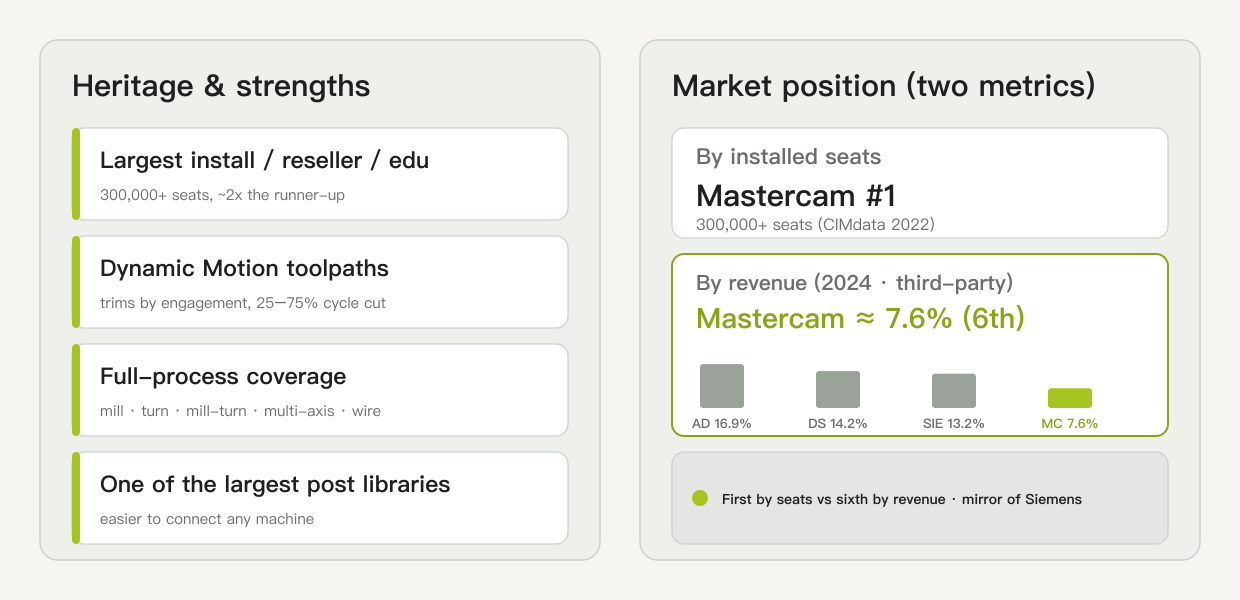
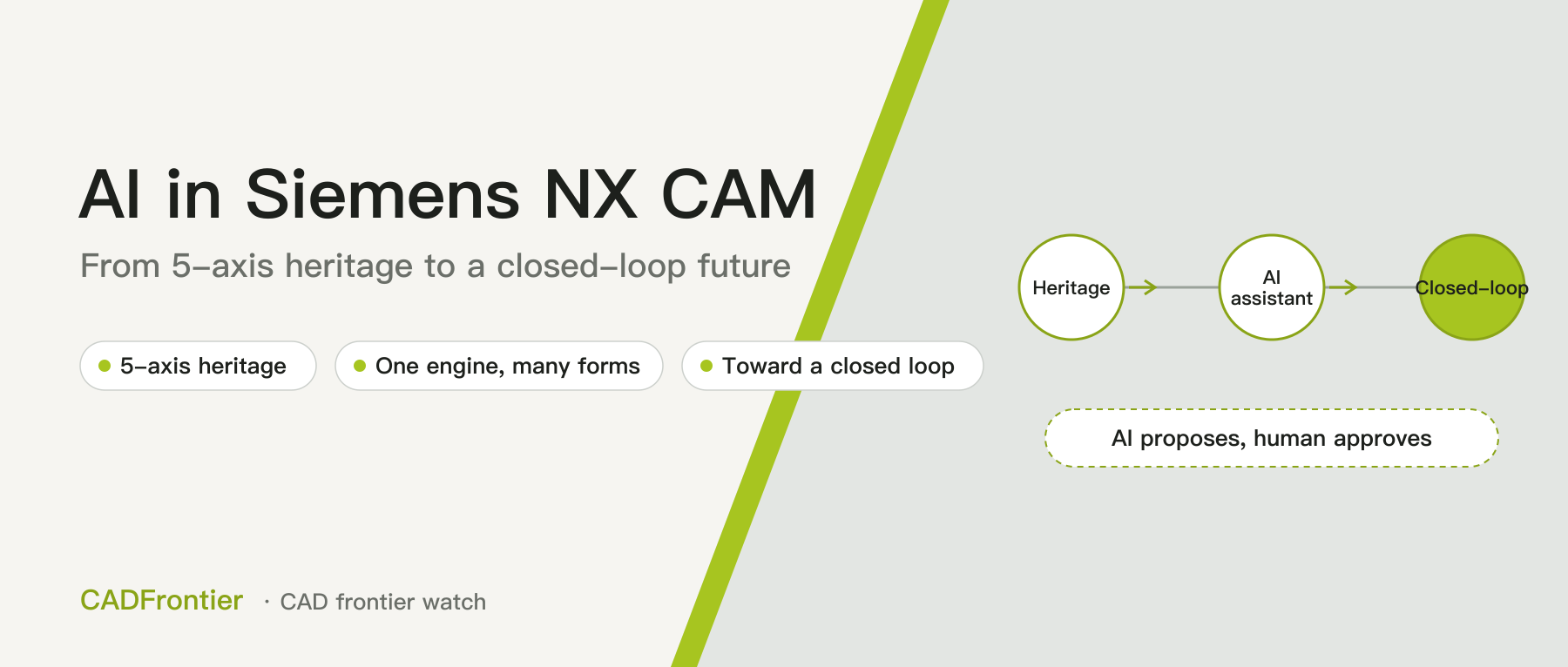
Figure 1: Mastercam's heritage, strengths and market position (first by seats vs sixth by revenue, a mirror of Siemens). Drawn by CADFrontier.
2. Architecture: standalone CAM, CAD-agnostic
Siemens' CAM is fused into NX, sharing a master model with CAD; Mastercam takes the opposite route, and that is the key to understanding it.
Mastercam's core is a standalone CAM system that is CAD-agnostic: it imports models from SolidWorks, Inventor, Creo, Solid Edge and neutral formats like STEP, then programs them in its own environment, tied to no single CAD or geometry kernel. Around that core are two more forms:
- Mastercam Design: built-in lightweight modeling, for patching surfaces, tweaking models, building fixtures and the like.
- Mastercam for SolidWorks: a variant that runs inside SolidWorks, for SW-centric users who want Mastercam toolpaths right in the SW environment.
The contrast with Siemens is clear: NX CAM is "fused" — change the design and the toolpaths follow, but you live in NX's world; Mastercam is "catch-all" — any CAD model can be brought in and programmed, but the model is an imported snapshot, so parametric linkage back to design is less seamless than a shared database. Each one's strength is the other's trade-off. For shops that use several CADs and take all kinds of work, Mastercam's CAD-agnosticism is a real convenience.
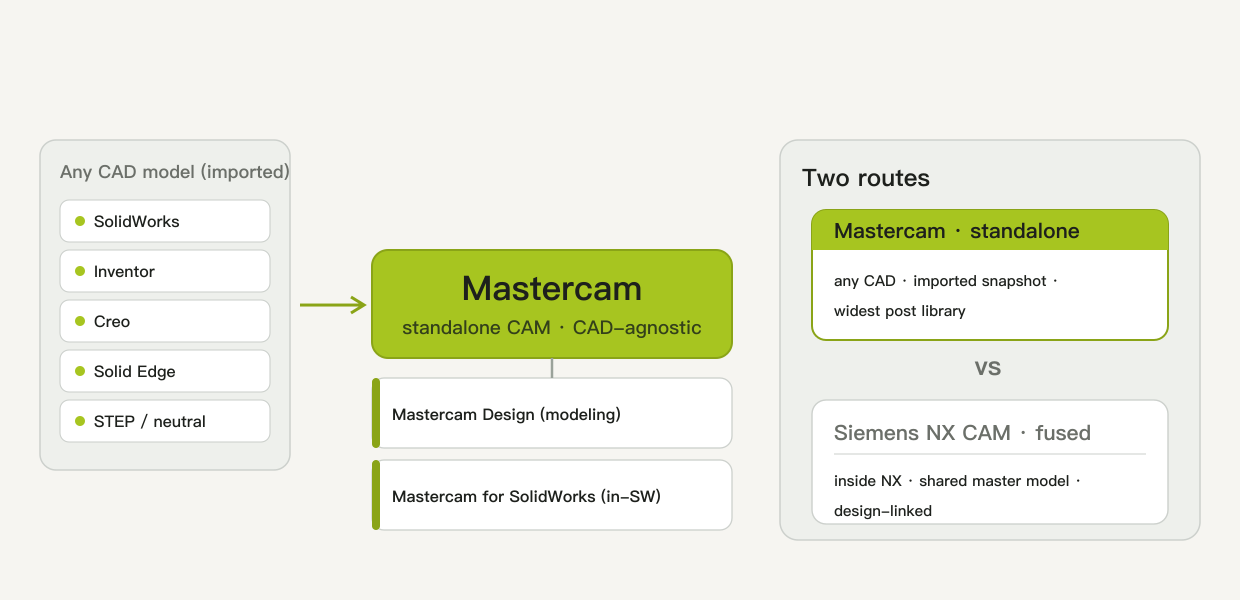
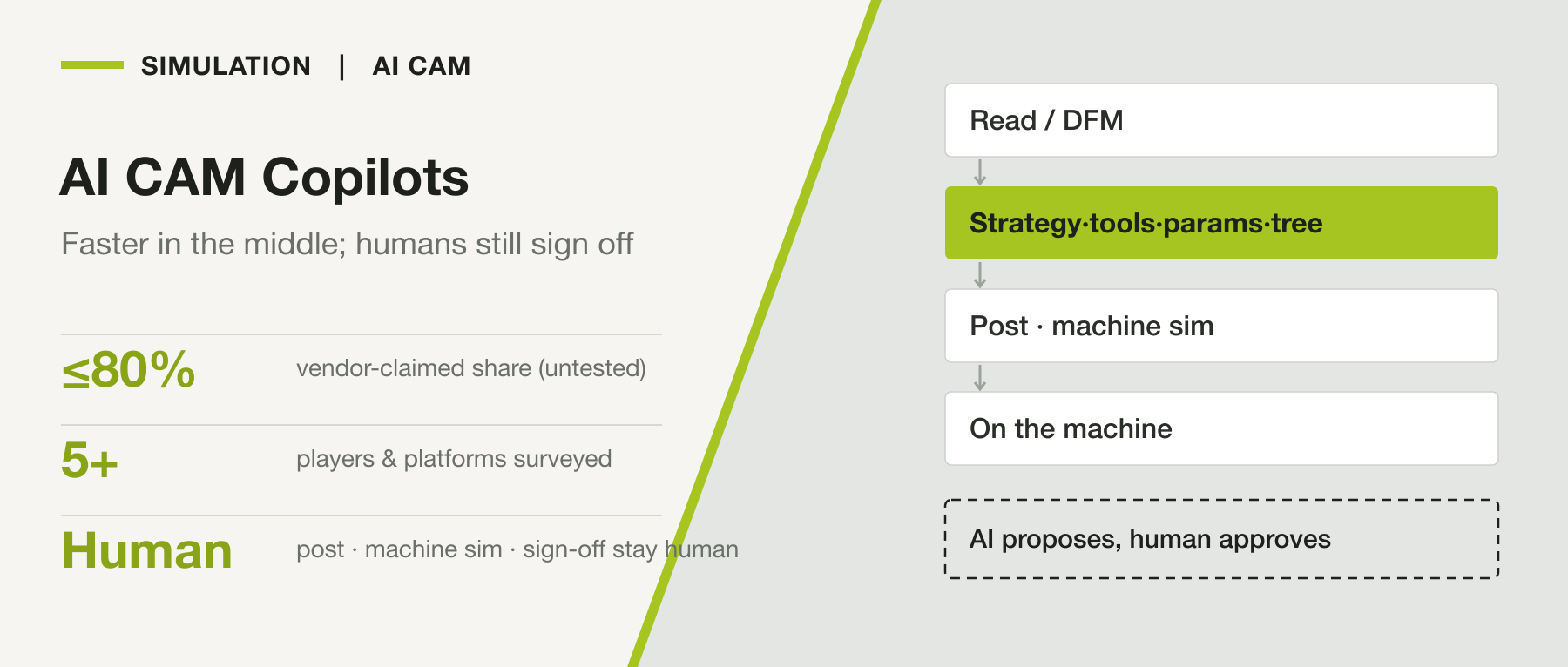
Figure 2: Standalone, CAD-agnostic Mastercam, contrasted with Siemens' route of fusing into NX. Drawn by CADFrontier.
3. The present: AI enters Mastercam
There are two AI lines here, most easily confused into one — so first, keep them apart:
- Mastercam Copilot (native, Sandvik's own): introduced in the 2026 release, and in 2026.R2 (February 2026) opened to all Mastercam Connect users (previously 1,500+ via an early-adopter program). It has Help and Command capabilities: adjust feeds and speeds across multiple operations by voice or text, covering about 200 toolpath types, and build a complete machine group from a verbal description. It is positioned as an assistant that speeds up programming and onboarding.
- CAM Assist (third-party CloudNC integration): brings CloudNC's strategy/toolpath generation into Mastercam, compatible with 2025/2026/2027; but it is a cross-platform third-party product (also for Fusion, NX, GibbsCAM, SolidCAM and more), not exclusive to Mastercam.
Beyond that, 2026.R2 brings up to 10x GPU-accelerated simulation and shifts to a twice-a-year release cadence.
The point: Mastercam Copilot is Sandvik's own roadmap, while CloudNC CAM Assist is a third-party you can plug in. This fits the overall landscape of AI CAM across vendors — AI focuses on strategy, tooling, parameters and the middle of programming, while post-processing and sign-off stay with people.
4. The future: the Sandvik ecosystem and cutting intelligence
Mastercam's future is best read within Sandvik's portfolio — which is also what sets it apart from other standalone CAM:
- Copilot keeps expanding: the roadmap mentions context-aware automation, feed-and-speed recommendations, and deeper integration with the wider Sandvik ecosystem.
- Sandvik Coromant CoroPlus Tool Library: integrated since the 2024 release, it recommends tools by material, operation and tool type, and can import 3D tool-assembly models into toolpaths for visualization, collision checking, and using an accurate model to validate cutting data and optimize before the job hits the machine. This is a resource unique to Sandvik as a cutting-tool giant — plugging "tooling and cutting data" straight into CAM.
- Simulation and cadence: GPU-accelerated simulation and a semi-annual cadence should speed up how fast capabilities iterate.
To be honest, this too is an incremental path: Copilot is assistant-level today, and CAM Assist's strategies still need human simulation, post-processing and sign-off — no one is promising one-click lights-out.
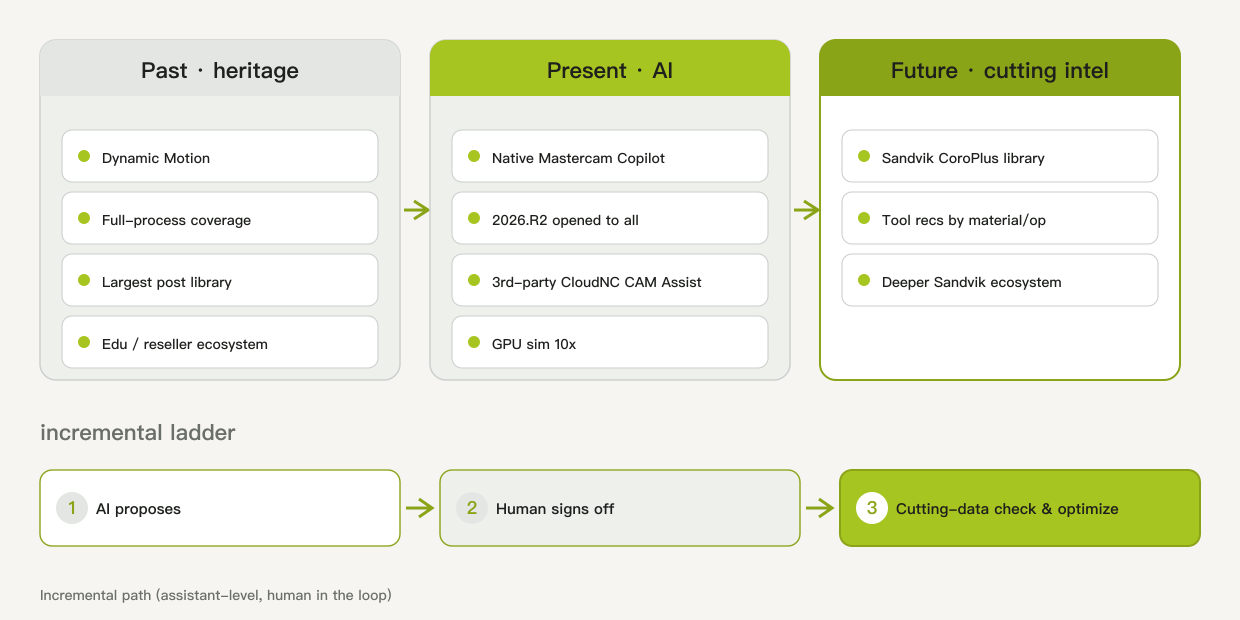
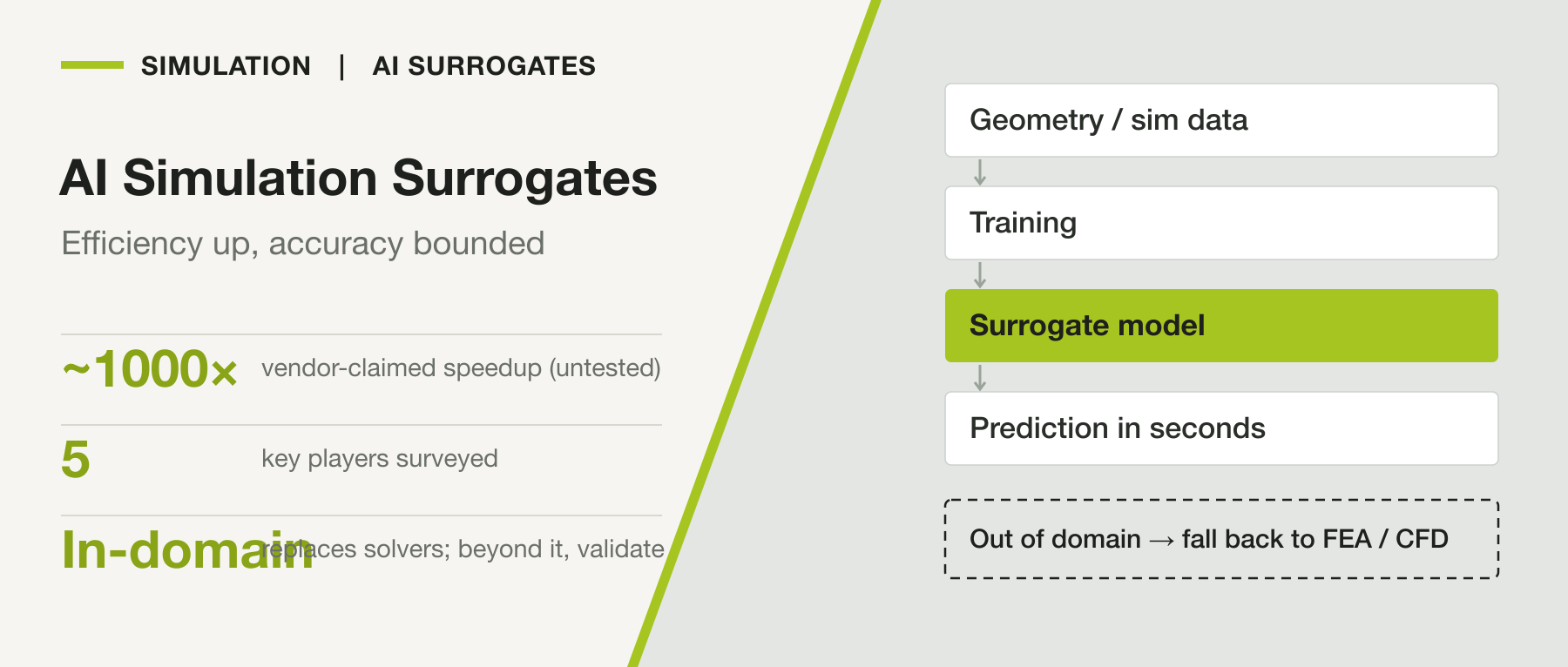
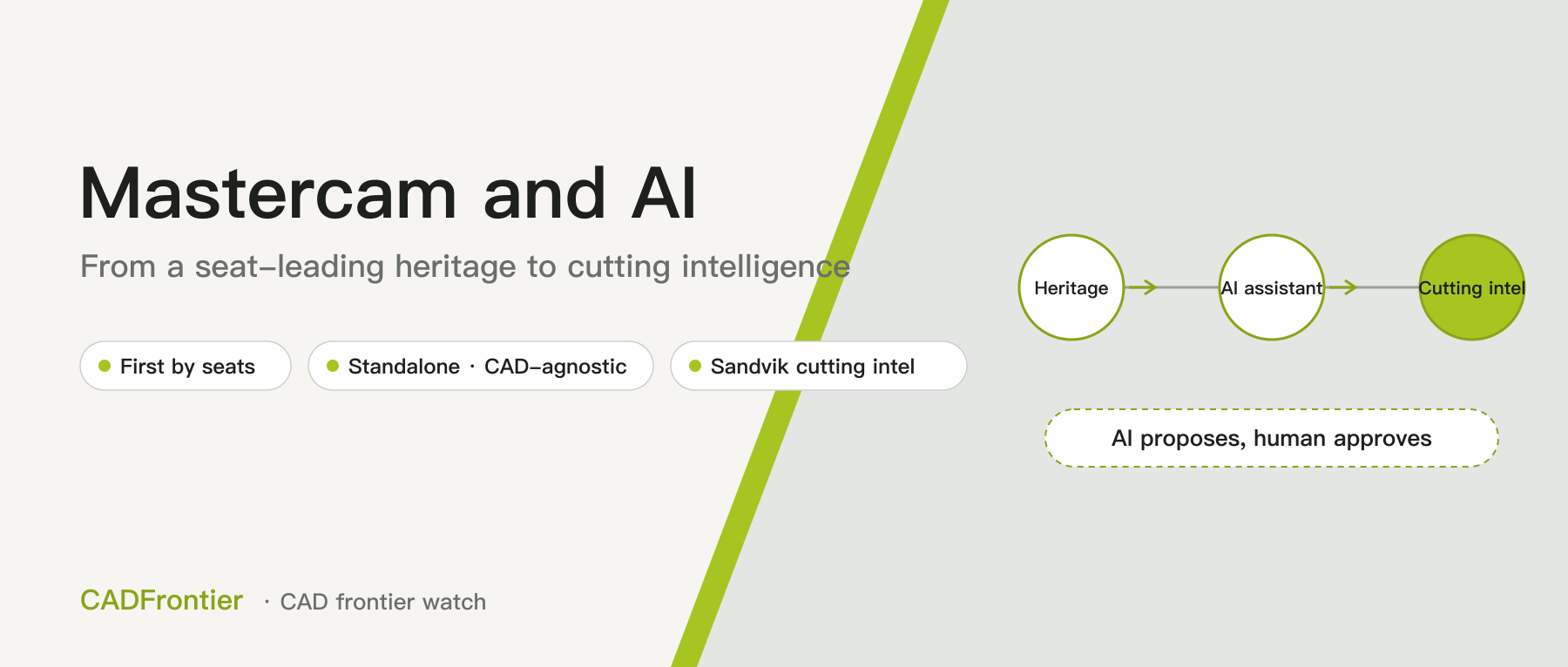
Figure 3: Mastercam's incremental path from heritage to AI to Sandvik cutting intelligence. Drawn by CADFrontier.
5. My view: two different routes
Pulling the threads together answers the question left in section 1 — what keeps Mastercam first on seats. Its moat is, precisely, not high-end algorithms but breadth and inertia:
- The largest installed base and reseller/machine-maker network: wide distribution and local service, so switching CAM is costly for a shop.
- The education channel: Mastercam is the first CAM many people ever learn, and habits carry through a career.
- CAD-agnosticism: any model can be brought in, suiting general job shops that take all kinds of work on various CADs.
- One of the largest post libraries: it is easier to "connect to" any machine — especially key for an SME-dominated market.
- Mature toolpaths like Dynamic Motion: a real efficiency in everyday milling.
And being acquired by Sandvik gave it a card no other standalone CAM holds: plugging tooling and cutting data (Coromant) into CAM. Back to the loop from the Siemens piece — Siemens holds a full-stack loop from CAM to the machine controller; Mastercam has a different loop: from CAM to tooling and cutting data. The two occupy opposite ends: one high-end and fused, deep into the controller; the other broad and standalone, deep into the tooling. For AI CAM's "trusted sign-off," the former is strong on machine-side control, the latter on the reliability of cutting parameters and tools — different paths, but both easing the human's load at the gate.
So my take: in the short term, both companies' AI is still at "propose, human approves"; but whoever binds their own loop (controller side, or tooling/cutting side) more deeply to AI is more likely to make the sign-off solid. Mastercam's lead on seats is hard to shake in the short term — not because one AI feature is strongest, but because "the widest net plus Sandvik's tooling card" is hard to replace.
This article is an editorial analysis based on public material; the share, revenue and performance figures follow third-party analyses and official material and were not independently tested or verified. The illustrations are conceptual diagrams drawn by CADFrontier.
Sources & further reading
- Wikipedia: Mastercam (history, CNC Software, Dynamic Motion) ↗Source region: International
- Engineering.com: Sandvik acquires CNC Software and the Mastercam CAD/CAM portfolio ↗Source region: International
- Sandvik: acquisition of CNC Software (Mastercam) investor presentation (installed base) ↗Source region: International
- Cutting Tool Engineering: CIMdata ranks Mastercam first by installed seats ↗Source region: International
- Report Prime: CAM software market share (revenue; Mastercam ~7.6%, sixth) ↗Source region: International
- Digital Engineering: Mastercam 2026 features AI-enabled CAM intelligence (Copilot) ↗Source region: International
- PR Newswire: Mastercam 2026.R2 — GPU-accelerated simulation and AI-powered assistance ↗Source region: International
- CloudNC: CAM Assist for Mastercam (third-party, cross-platform) ↗Source region: United Kingdom
- PR Newswire: Mastercam 2024 integrates Sandvik Coromant CoroPlus Tool Library add-in ↗Source region: International
- Sandvik Coromant: CoroPlus Tool Library add-in for Mastercam ↗Source region: International