AI in Siemens NX CAM: from 5-axis heritage to a closed-loop future
Is Siemens' CAM fused into NX or standalone? We sort out NX CAM's single engine and several delivery forms, its 5-axis heritage and market position (seats vs revenue), its present AI (CAM Assist, AI-MMS, 2606 generative and closed-loop), and a future headed toward closed-loop self-correction.
In this article
After the overview of AI CAM, this article looks at Siemens alone. It is one of the benchmarks in high-end CNC programming — holding both an NX CAM product developed over decades and a fast-moving push to embed AI into it. We take it in three parts: the past (its heritage, and why it leads), the present (its AI), and where it is headed. First we need to clear up something often confused — whether Siemens' CAM is fused into NX or a standalone product. Sources were checked as of October 31, 2026.
1. The past: NX CAM's heritage, and why it leads
Siemens' CAM engine is NX CAM, with a lineage going back to Unigraphics: in 2007 Siemens acquired UGS and folded Unigraphics into NX, with CAM developing ever since as the manufacturing module inside it. Its traditional strengths cluster at the high end:
- 5-axis machining: high-speed adaptive roughing, finishing along guiding curves, swarf (flank) cutting, and Auto-Tilt — automatically pivoting the tool axis to clear the workpiece when the holder is about to collide.
- Feature-based machining (FBM) and PMI-driven machining: it reads manufacturing information such as tolerances and surface finish from the model and selects matching operations from an editable knowledge base, cutting down on repetitive setup.
- Sinumerik post-processing: a built-in Post Builder and post-processors optimized for controllers like the Sinumerik 840D, emitting controller-native statements such as CYCLE800 (swiveling) and TRAORI (5-axis transformation), plus high-speed-cutting tolerance, velocity and jerk settings.
- Virtual machine simulation: Run MyVirtual Machine performs G-code-driven (ISV) simulation — running the actual G-code that will reach the controller, so you see the machine's real travels, axis speeds and over-travel risks before loading a tool.
Because of all this, NX CAM is repeatedly called the de facto gold standard for high-complexity, multi-axis parts in aerospace and medical work.
"Leads" needs to be stated precisely, without overclaiming. By installed seats, the global number one is Mastercam (300,000+ seats, top for many years); Siemens is not the seat leader. By a different metric it looks different: by revenue, a third-party analysis (reportprime, 2024 CAM figures) puts Autodesk at about 16.9%, Dassault at about 14.2% and Siemens Digital Industries Software at about 13.2%, third (its flagship being NX CAM), with Mastercam around 7.6% — a revenue rank well above its seat rank, which says its seats are pricier and concentrated at the high end. For context, CIMdata puts the 2025 CAM market at about USD 3.1 billion, up roughly 9.5% year on year. In China, public reports generally hold that Dassault, Siemens and PTC take most of the CAM market with a low domestic share; by IDC's China CAD figures, Dassault was first and Siemens second in 2025 (with overall share being chased by domestic vendors). And "high-end multi-axis plus complex surfaces" is exactly the part hardest to replace domestically, where foreign vendors still dominate.
In other words: the seat champion is Mastercam, but in high-end multi-axis and on revenue, Siemens is a leader alongside Dassault and Autodesk, and the de facto benchmark for aerospace and medical complex parts. Why it stays steady at the high end is left to section 5 — which turns out to be the same thing as why it has the footing to do AI.
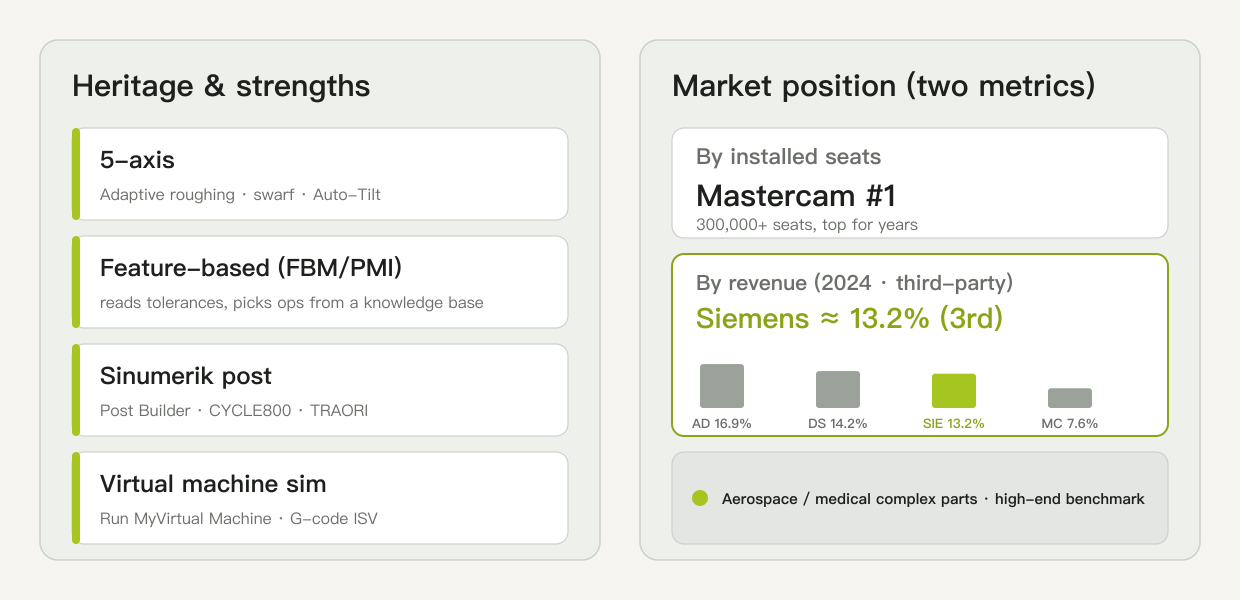
Figure 1: NX CAM's heritage, traditional strengths and market position (seats vs revenue). Drawn by CADFrontier.
2. Architecture: one engine, several forms
To make clear where Siemens' CAM actually lives and whether it comes standalone, the key is to separate the "engine" from the "delivery shell," then sort out its relationship to Designcenter.
The core is always one NX CAM engine, and it shares a single master model with NX's CAD — change the design and the toolpaths can follow. That is what sets it apart from a standalone CAM that imports a dead model and programs on it. Around that engine, Siemens delivers in several forms:
- NX (desktop): CAD/CAM/CAE in one, with CAM as the manufacturing application inside it.
- NX X Manufacturing: the cloud (SaaS) version of NX CAM; since April 2026 there is also a CAM-only edition that does manufacturing without full CAD, and capabilities like AI Make Machining Suggestion are exclusive to NX X Manufacturing.
- Solid Edge CAM Pro: CAM inside Solid Edge, also powered by the NX CAM engine.
- Historically there were also the CAM-focused NX CAM Express / Mach packages that can import external CAD.
So the answer is: there is only one engine (NX CAM); it is both deeply fused into NX and deliverable in a CAM-focused or cloud-standalone form.
The easy confusion is Designcenter. Designcenter is NX's design-side new environment, and Siemens' Design Copilot lives there — that is AI for design/CAD (searching docs, finding commands, speeding up modeling). The CAM AI is a separate set: AI-MMS, CAM Assist and the NX X Manufacturing Copilot, all in the manufacturing environment, not in Designcenter. Our earlier piece on AI in Siemens NX was about the design side; this one is about the manufacturing side, and the two do not overlap.
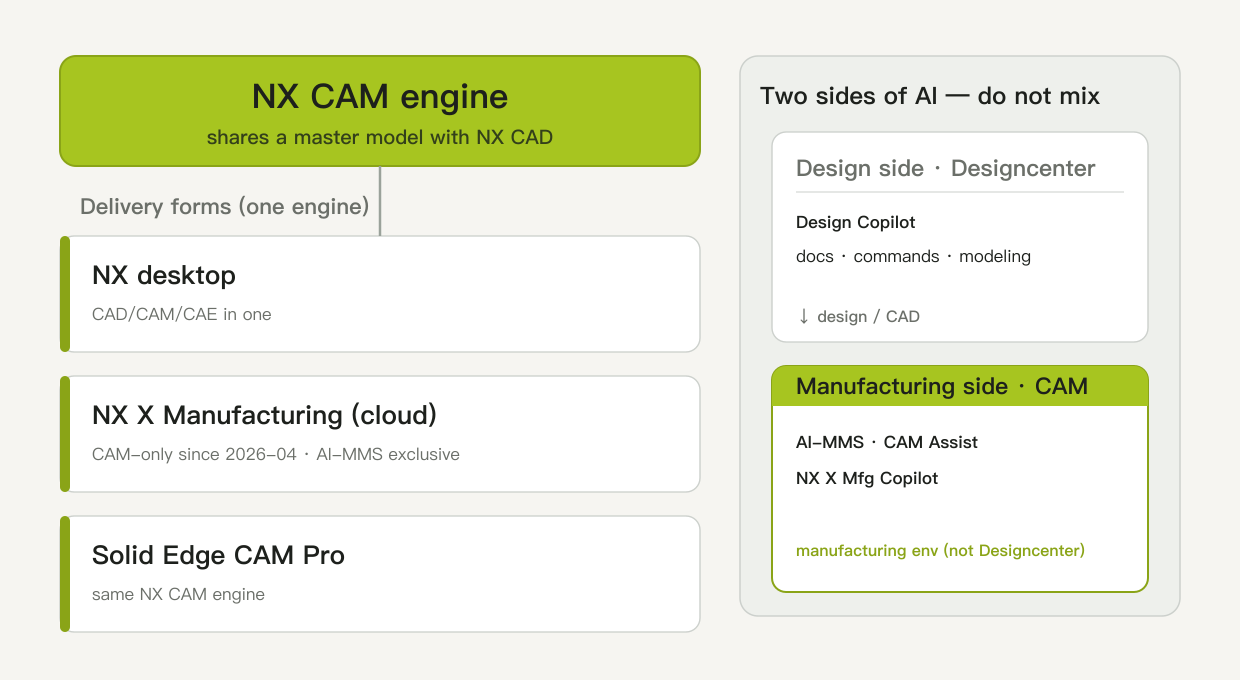
Figure 2: One NX CAM engine, several delivery forms, and the split between design-side (Designcenter) and manufacturing-side (CAM) AI. Drawn by CADFrontier.
3. The present: AI enters NX CAM
The AI Siemens is pushing into NX CAM runs along a few lines, all inside the manufacturing environment:
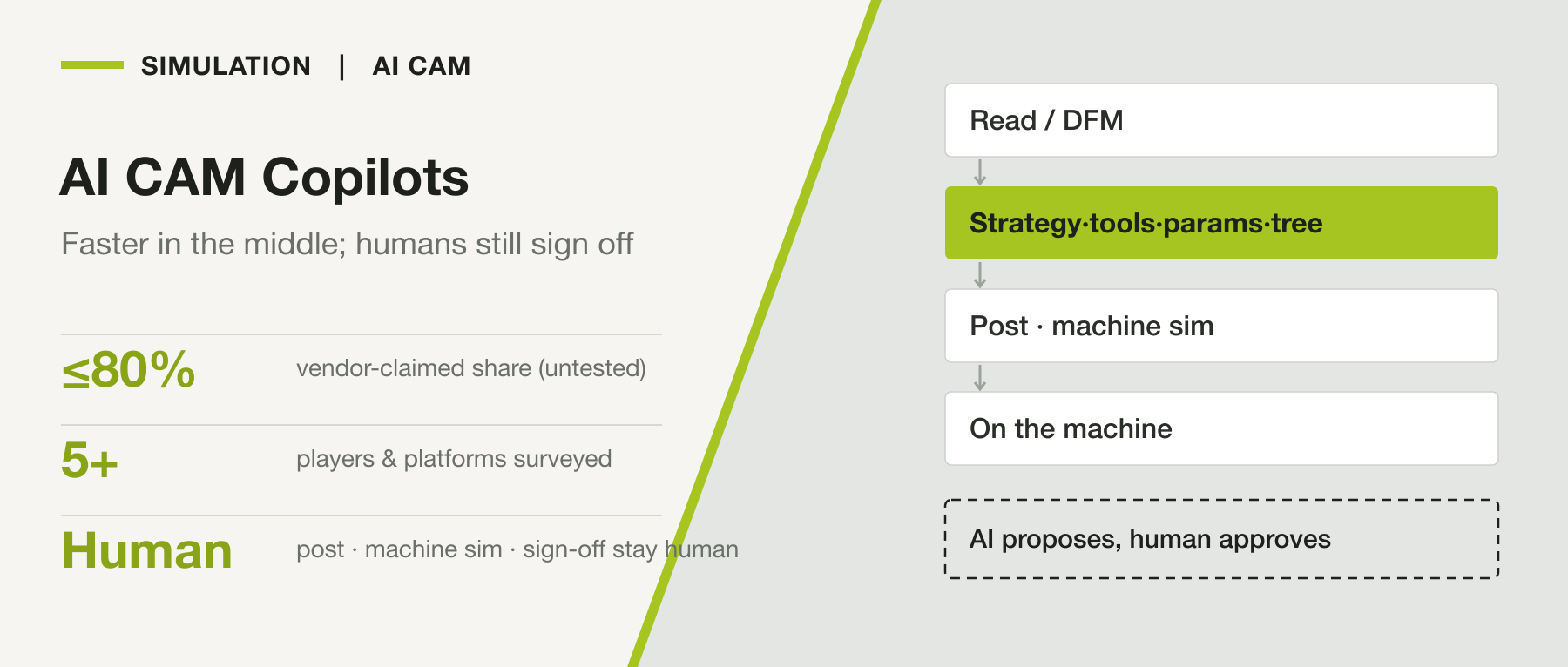
- CAM Assist (integrating CloudNC): automatically generates 3-axis and 3+2-axis machining strategies, markedly speeding up toolpath generation; CloudNC's reach has grown from 3-axis to multi-axis.
- AI Make Machining Suggestion (AI-MMS): in NX X Manufacturing, using an LLM plus the user's own historical data — select a face, right-click "Make Machining Suggestion," and get three complete suggestions (operations, tools, cutting parameters), aimed at prismatic features and 2.5/3-axis; when history is thin you can upload previous part files for it to learn from, and save tuned suggestions as "rule-based" alongside "AI-based" ones.
- NX X Manufacturing Copilot: a conversational assistant on the manufacturing side, giving programmers context-aware prompts and guidance.
- Two steps in NX 2606 (June 2026): first, AI-MMS adds a generative third kind of suggestion — where suggestions were once bounded by historical data and the existing tool library, now, when a suggestion needs a tool not in the library, it no longer stops but can auto-create a parametric tool; second, on-machine probing, alignment, tool control and adaptive machining are brought into a single closed-loop CAM workflow, built in rather than bolted on.
In short, Siemens has made AI into "speeding up programming inside the manufacturing environment," along a relatively steady path — emphasizing rule templates and reuse of historical data rather than one-click "autopilot" from the start. This fits the overall landscape of AI CAM across vendors: AI focuses on the middle — strategy, tooling, parameters, the operations tree — while post-processing and sign-off stay with people.
4. The future: toward closed-loop self-correction
The direction in Siemens' public material is not a slogan but something already landed in 2606 features, pointing further:
- Closed-loop adaptive machining: 2606 builds on-machine part/tool probing, in-process alignment, automatic tool correction through Cut-Measure-Cut cycles, and standardized postprocessor layers that drive closed-loop decisions — all into the CAM structure itself. Siemens' own phrasing: these reduce reliance on shopfloor macros, improve first-time-right rates, and bring CAM a meaningful step closer to "fully autonomous, self-correcting machining."
- Digital-twin loop: Run MyVirtual Machine is itself a 1:1 digital twin of the Sinumerik ONE / 828D controller, running real NC code in a virtual environment and aligning tightly with NX CAM toolpaths — keeping "what was programmed" and "what runs on the machine" as close as possible.
- Toward lights-out: with probes from BLUM, Renishaw and others feeding measurement data back to the Sinumerik controller to auto-correct toolpaths to tighter tolerances, industry cases (such as SIXDIGMA and DMG MORI practice) already point toward reduced- or un-manned production.
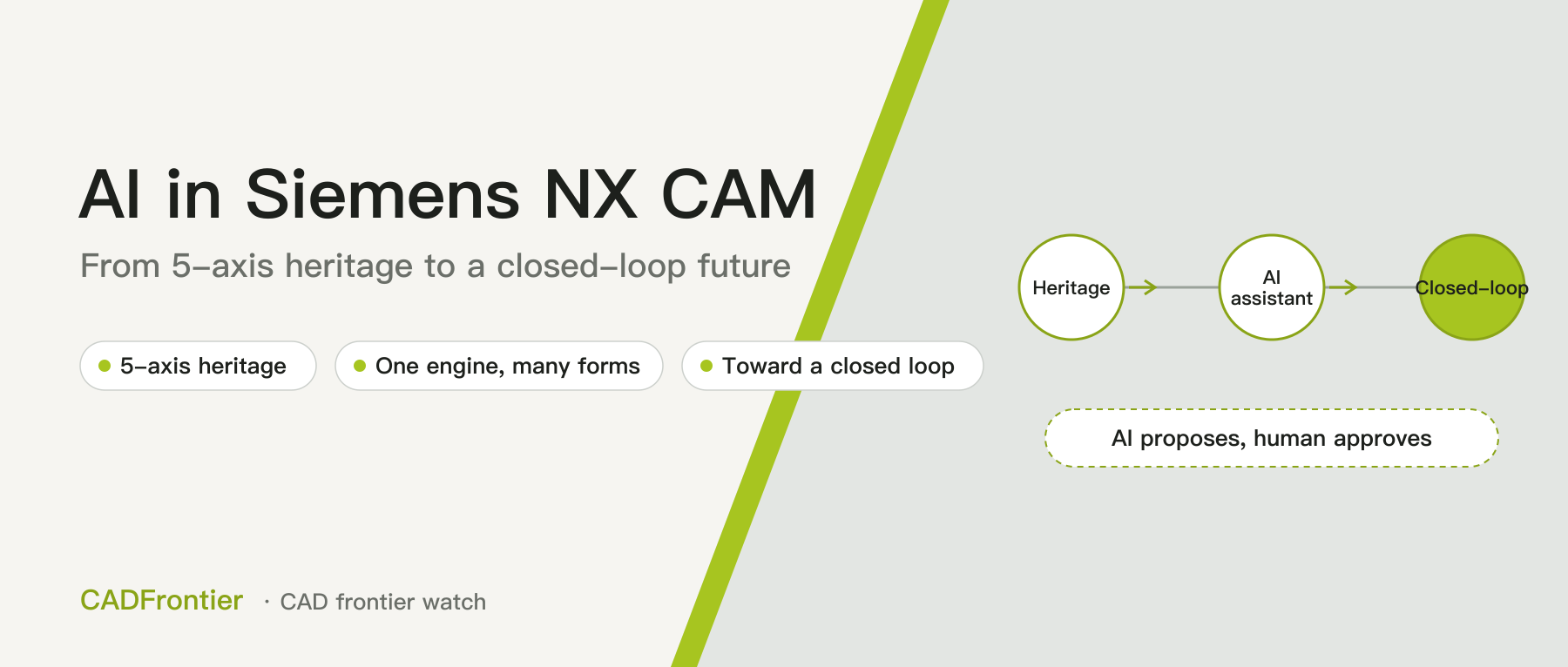
To be honest about it: Siemens describes an incremental path toward autonomy, not a formal "levels of autonomy" scale like self-driving. So the accurate framing is that the chain "AI proposes → human reviews and signs off → closed-loop self-correction with measurement feedback" is becoming real step by step, not a single switch that flips to lights-out.
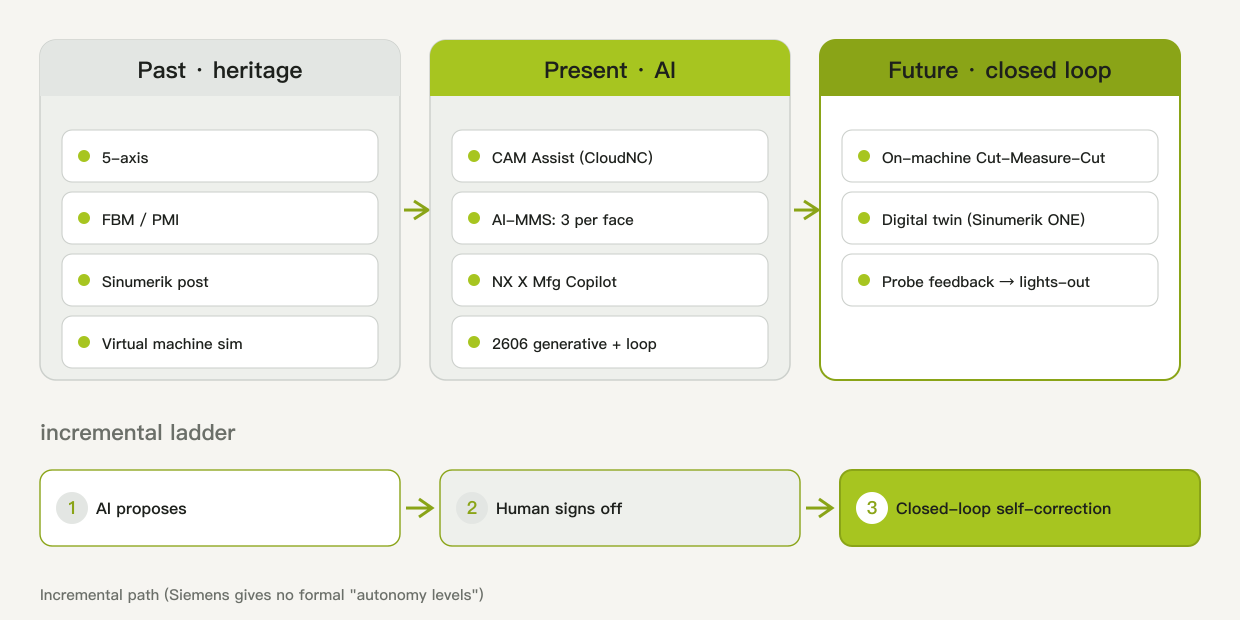
Figure 3: The incremental path from heritage to AI to closed-loop self-correction. Drawn by CADFrontier.
5. My view: why the share holds
Pulling the threads together answers the question left open in section 1 — what keeps Siemens steady at the high end. I see five reasons, stacking on each other:
- One master model: CAM shares a database with NX CAD, so design changes flow into toolpaths — a real efficiency when high-end parts are revised often.
- Deep 5-axis and complex-surface algorithms: collision avoidance, swarf, adaptive roughing are must-haves for aerospace and medical parts, an accumulation no assistant alone can close.
- An in-house full-stack loop: from NX CAM → Post Builder/Sinumerik post-processing → Run MyVirtual Machine → the Sinumerik controller, it is one in-house chain; other CAM often has to bolt on third-party posts and controllers. That chain makes "reliable sign-off, fewer crashes" more assured.
- Integration with Teamcenter/Tecnomatix: once a large enterprise ties its process to this PLM, switching costs are high.
- Certification and machine-tool ecosystem at the high end (deep partnerships with the likes of DMG MORI) create stickiness.
And these are exactly where Siemens gets its footing for AI CAM. Back to the bottleneck the AI CAM piece keeps stressing: the hard part was never just "can it generate a toolpath," but "can it match the specific machine and process, and can it be trusted to be released." Siemens holds a full-stack loop running from CAM all the way to the machine controller — precisely what others lack most, and the stretch where "trusted sign-off" is hardest. In the short term it is, like everyone, still "AI proposes, humans approve"; but in the long term, whoever makes the sign-off stretch solid is more likely to move from "assistant" to "more autonomous" — and on that, Siemens starts ahead of most. It also explains why its high-end share holds: not that one AI feature leads, but that this loop itself is hard to replace.
This article is an editorial analysis based on public material; the share and performance figures follow third-party analyses and official material and were not independently tested or verified. The illustrations are conceptual diagrams drawn by CADFrontier.
Sources & further reading
- Siemens NX Manufacturing blog: NX CAM product page ↗Source region: International
- Siemens: What's new in NX for Manufacturing 2606 (June 2026) ↗Source region: International
- Engineering.com: AI Make Machining Suggestion now in Siemens NX X Manufacturing ↗Source region: International
- Siemens: How Siemens CAD/CAM and CloudNC are bringing AI machining to the shop floor ↗Source region: International
- Siemens: Closed-loop adaptive machining using NX CAM ↗Source region: International
- Siemens: Get it right the first time — digital twin in parts manufacturing ↗Source region: International
- DMG MORI: Siemens NX CAD/CAM (5-axis, adaptive machining, probing) ↗Source region: International
- Report Prime: CAM software market share (revenue, vendor ranking) ↗Source region: International
- Mastercam: ranked #1 in installed seats worldwide by CIMdata ↗Source region: United States
- IDC 2025 China CAD market share (Dassault first, Siemens second) ↗Source region: Mainland China
- MachineToolNews: Is 2026 the rise of the manufacturing copilot? (CAM market size) ↗Source region: International