Skyfall SKY-001 Engineering World Model: Distinguishing Itself from General Large Models
Skyfall AI says its engineering world model SKY-001 matches frontier LLMs on quality while running roughly 50 to 120 times faster. We check the multipliers, evaluation setup, scale claims and availability against the vendor's own pages.
In this article
On October 19, 2026, Skyfall AI released a research preview of SKY-001, which it calls the first engineering world model. The company reports that on CAD and BIM tasks it matches frontier language models on quality while running roughly 50 to 120 times faster and costing roughly 150 to 190 times less [1][2]. This article checks those statements against Skyfall's own product page and technical blog and identifies what the public material does and does not support. Sources were checked as of October 25, 2026. All figures are self-reported by the vendor; CADFrontier has not reproduced them and has not had access to the model.
1. What the model does and does not do
SKY-001 has two stages [2]. A Hierarchical Composer turns an image or a text description into a design tree of assemblies and parts. A Construction World Model then predicts, for each leaf part, the sequence of visual states that builds it. For BIM, the input is a building outline and a short brief, and the output is a sequence of floor-plan drawing states.
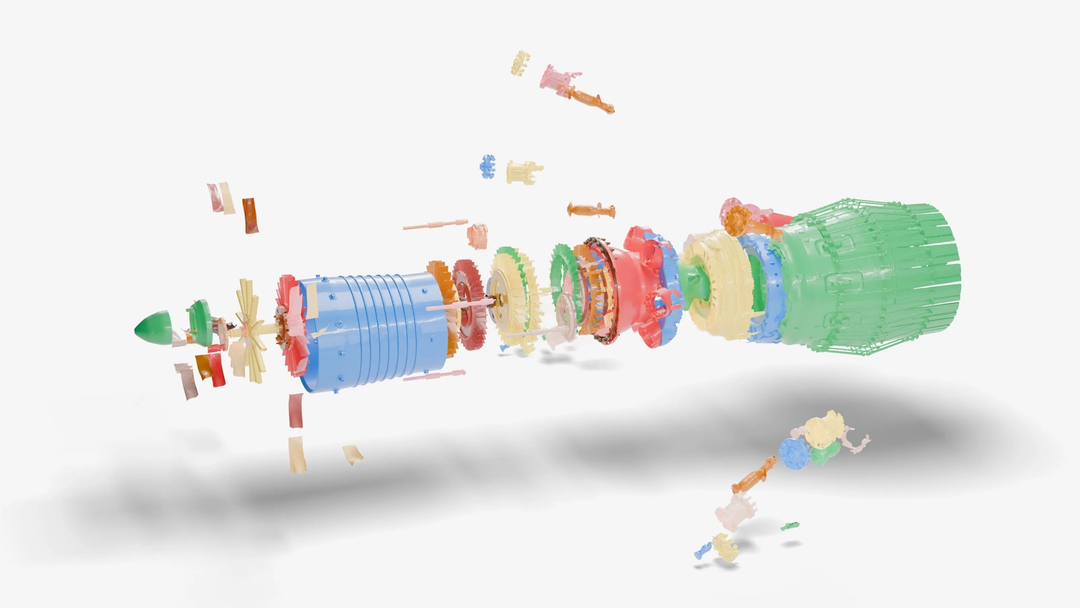
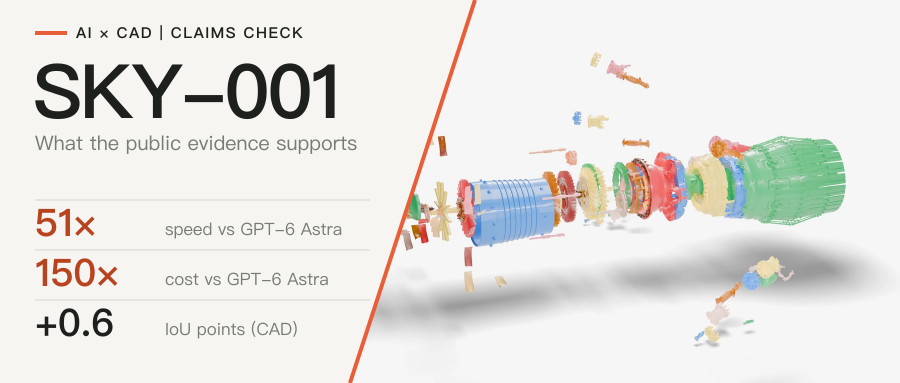
Figure 1: An image from Skyfall AI's technical blog showing a jet engine split into individually colored parts (vendor image; CADFrontier cannot independently confirm that it was generated by SKY-001). Source: share image of Skyfall AI's blog post Introducing SKY-001, © Skyfall AI.
Two points need to be separated. First, in its "What Comes Next" section the blog says that CAD sketch rollouts "would become" executable operations with an editable feature history [2], which indicates that the current output is not an editable parametric feature history. Second, some press coverage describes the model as outputting steps that can be executed in software such as Autodesk Fusion [3]. That description does not match the roadmap in Skyfall's own blog, which should take precedence.
2. The reported data
The table below gives the benchmark results published in the blog; the ratios are calculated by this article from the figures in the table [2].
| Task | Model | Mean IoU | Time per case | Cost per case |
|---|---|---|---|---|
| CAD (1,000 components) | SKY-001 | 79.7% | 3.9 s | $0.005 |
| GPT-6 Astra | 79.1% | 199 s | $0.75 | |
| Gemini 4 | 76.9% | 253 s | $0.25 | |
| BIM (1,000 floor plans) | SKY-001 | 43.6% | 1.22 s | $0.0024 |
| GPT-6 Astra | 40.6% | 144.6 s | $0.446 | |
| Gemini 3.8 Flash | 42.3% | 346.2 s | $0.218 |
On these figures, relative to GPT-6 Astra, the CAD task is about 51 times faster and 150 times cheaper, and the BIM task about 119 times faster and 186 times cheaper.
3. Findings
The multipliers are not stated consistently. The blog describes the CAD result as "about a 50× speedup", while the FAQ on the product page says "100 times the speed and 1/150th the cost" [1][2]. By the blog's own table, 100 times is close only to the BIM figure of 119 times, and the 150-fold cost ratio applies only to the most expensive comparator, GPT-6 Astra. Against Gemini 4 ($0.25) the ratio is about 50, and against Kimi K3 ($0.13) about 26.
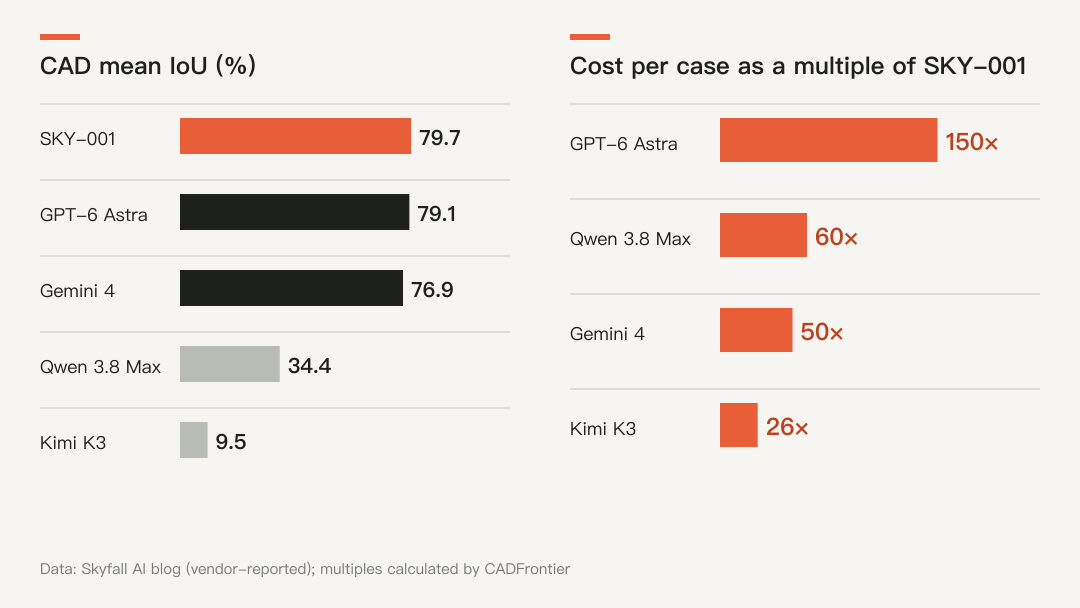
Figure 2: Mean IoU on the CAD benchmark (left) and each model's cost per case as a multiple of SKY-001 (right). Data from Skyfall AI's blog (vendor-reported); multiples calculated by CADFrontier; chart drawn by CADFrontier.
The margin behind "matching quality" is small. On CAD the difference is 0.6 percentage points. On BIM it is 3.0 points against GPT-6 Astra and 1.3 points against Gemini 3.8 Flash. The performance section of the blog gives no number of runs, variance or confidence intervals, so it is not possible to tell whether these differences exceed run-to-run variation.
The list of comparison models differs between the two pages. The product page's CAD chart includes Claude Opus 5.5 (69.4%) and Gemini 3.8 Flash (54.7%), whereas the blog's CAD chart includes Gemini 4 (76.9%) and no Claude model [1][2]. The values for GPT-6 Astra, Qwen 3.8 Max and Kimi K3 are the same on both.
The evaluation setup is under-described. The blog does not say what input the benchmark uses or how the language models were prompted, and neither page links to the benchmark dataset or evaluation scripts [1][2]. The test samples are drawn from complex objects such as a Jaguar E-Type, a FANUC ArcMate 100iB and a jet engine, while training used more than 200,000 parts and over 600,000 construction examples [2]. The blog does not state whether the test samples are held out from the training data. Startup Fortune likewise notes that the benchmark still has to be shown to hold up outside its own test set [3].
The composer is scored by language-model judges. For this component, two judges (GPT-6.1 Sol and Claude Opus 5.5) scored renders blindly; SKY-001 received 7.8 for part decomposition against 6.4 for GPT-6 Astra, and the blog notes that GPT-6 Astra returned a model for only 82% of assets [2]. No comparison with human ratings is given.
The claims about scale go beyond the data shown. The product page says SKY-001 excels at objects with "hundreds of thousands of parts" [1]. The training data described in the blog has a median of 288 parts per object and a 99th percentile of 4,180, and each CAD benchmark component takes about 100 drawing steps [2]. These figures do not by themselves support claims at the scale of hundreds of thousands of parts.
Availability. SKY-001 is a waitlist-only research preview with no API, published pricing, parameter count or released weights; commercial deployment is targeted for early 2027 [3].
4. Conclusion
On Skyfall's own benchmarks, SKY-001 is reported to come close to the strongest general-purpose model in quality while using about two orders of magnitude less time and cost. This article regards that as a preliminary, vendor-reported result. The order of magnitude of the speed and cost advantage is supported by the vendor's tables. The quality gap is small and comes without any information on variance. The benchmark is not public, its relation to the training data is not described, and the output is not yet an editable CAD feature history. Assessing its value for real design work would require, at a minimum, a public benchmark, held-out samples, repeated-run results and a way for third parties to try the model.
Sources & further reading
- Skyfall AI product page: SKY-001 ↗Source region: United States
- Skyfall AI blog: Introducing SKY-001: The First World Model for Engineering ↗Source region: United States
- Startup Fortune: Skyfall AI unveils SKY-001, a world model built only for engineering ↗Source region: United States