OCCT: the only mature open-source CAD kernel — and where it lags commercial ones
OCCT is the only mature, full-scale open-source geometry kernel, underpinning FreeCAD, build123d and many more. Using the 8.0 release, we set out what other open kernels exist, who uses OCCT, how far it lags commercial kernels on fillets and Booleans, and where it is headed.
In this article
For text-to-CAD and code-based CAD to land in practice, the geometry they generate eventually has to run on some geometry kernel — and how robust and interoperable that kernel is decides whether the generated geometry can enter an engineering workflow. Commercial kernels (such as Siemens' Parasolid and Dassault's ACIS) require license fees and are closed-source; on the open-source side, OCCT (Open CASCADE Technology) is the only mature, full-scale boundary-representation (B-Rep) kernel, developed since 1999, around two million lines of code, released under the LGPL, and underpinning a large swath of open-source CAD/CAE/BIM tools. In May 2026 it shipped 8.0.0 (now 8.0.1), its largest single-version step in years. Using that release as a vantage point, this article looks at the state of this open-source foundation: what other open kernels exist, who uses OCCT, how it compares with commercial kernels, and where it is headed. Sources were checked as of October 31, 2026; we did not compile-test everything, and the information follows official release notes and public repositories.
1. Open-source kernels: OCCT dominates, newcomers are early
A geometry kernel is the engine a CAD system hides. On the commercial side there are Parasolid, ACIS/ShapeManager, CGM, C3D and others; on the open-source side, the only mature, full-scale one is OCCT. It supports exact B-Rep solids, Booleans, fillets, surfaces and data exchange — the only open option in the same league as the commercial ones.
A few newcomers have appeared in the last couple of years, mostly in Rust and still early:
- Truck: a Rust B-Rep + NURBS kernel, Apache-2.0, targeting WebGPU; but it currently supports only single-edge fillets.
- Fornjot: Rust, experimental, and by its own account not yet suited to real projects.
- Gensolid: Apache-2.0, positioned against Parasolid, using Truck as its NURBS reference and OCCT for comparison (with no OCCT-derived code, due to license incompatibility).
- There is also the SMLib subset NVIDIA open-sourced under Apache-2.0 in USD BRep, and the long-standing BRL-CAD (with a CSG heritage).
These projects are interesting directions, but on robustness — especially Booleans and fillets — they are still clearly behind OCCT. In other words, if you want a license-free, production-usable open full-scale kernel, today there is still only OCCT. We have also discussed where open-source kernels sit in AI×CAD in the mainstream CAD AI landscape.
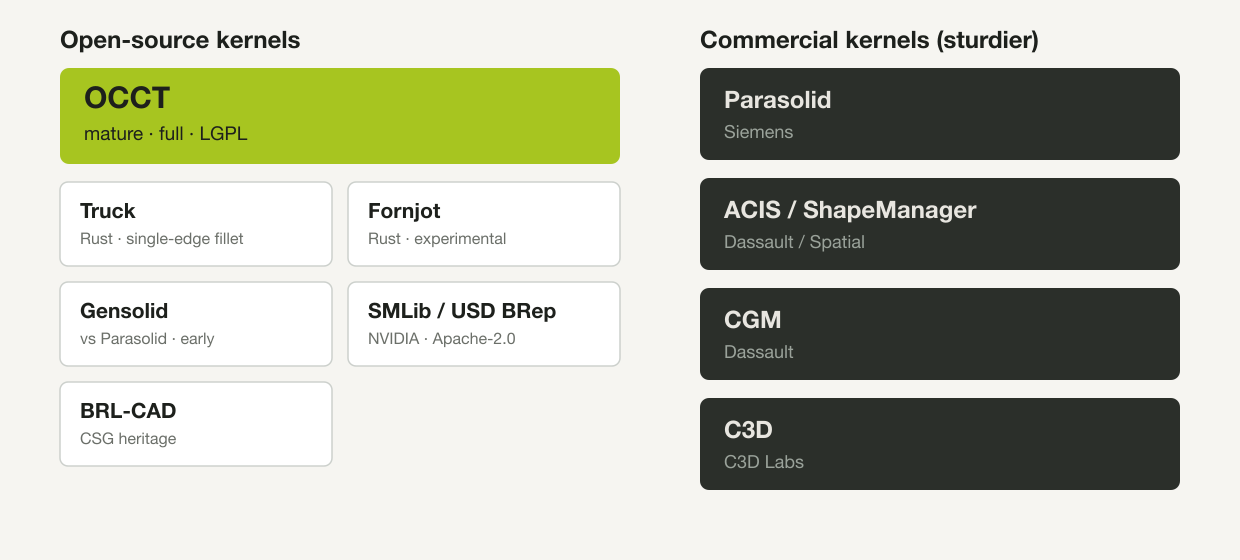
Figure 1: Open-source kernels (OCCT dominant, newcomers early) and commercial kernels. Drawn by CADFrontier.
2. Who uses OCCT
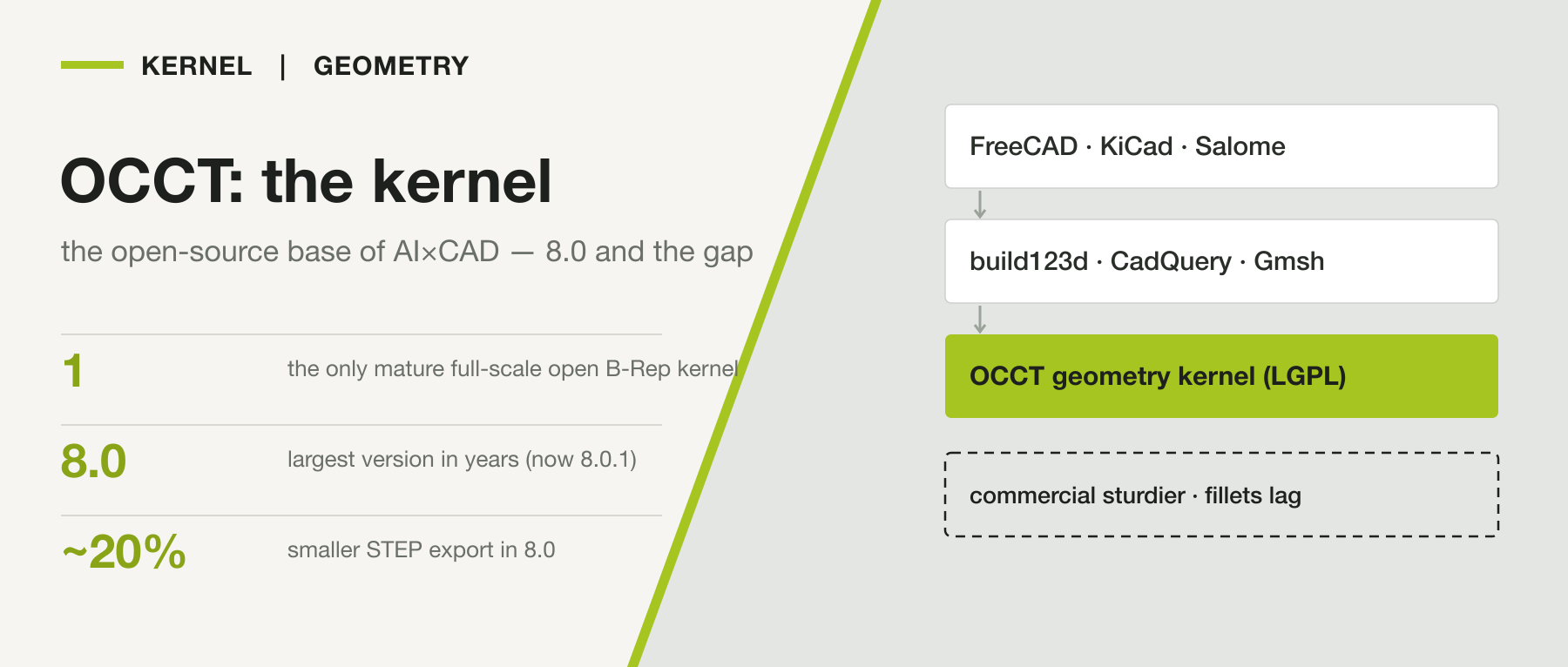
OCCT matters because a large set of tools are built on it: FreeCAD (open-source parametric CAD), KiCad's 3D viewer, build123d and CadQuery (through the Python binding OCP), Gmsh and Netgen for meshing and simulation pre-processing, IfcOpenShell and many IFC viewers in BIM, the Salome simulation platform, Open Cascade's own CAD Assistant, and web tools like bitbybit.
In other words, one kernel underpins a large part of the open-source CAD/CAE/BIM ecosystem. That is also why every major version moves a whole community — when the kernel changes, everything upstream has to follow.
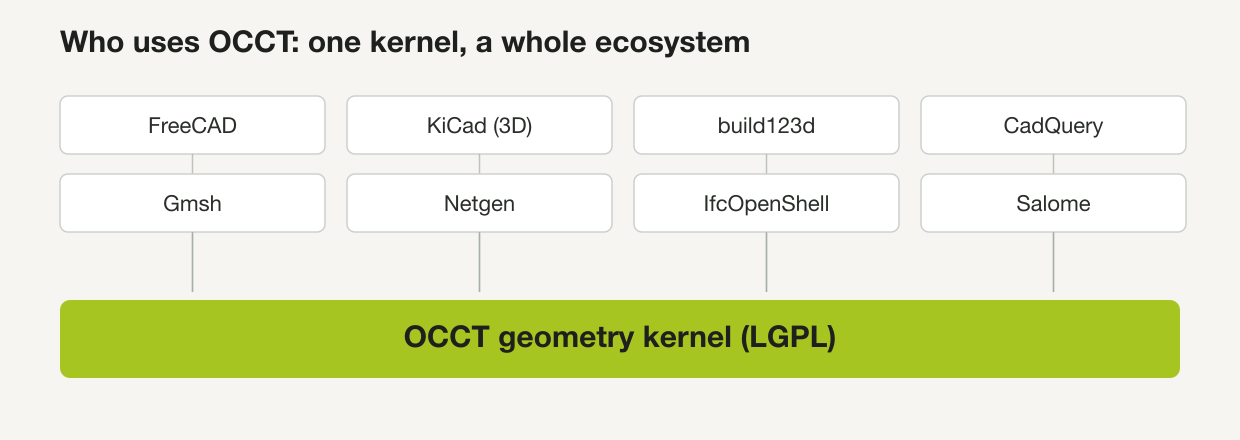
Figure 2: A large set of open-source tools are built on the OCCT geometry kernel. Drawn by CADFrontier.
3. Version 8.0: the foundation keeps modernizing
8.0.0 is OCCT's biggest step in years: after five release candidates and three betas, it accumulated more than 500 changes. It is a breaking release — the minimum C++ standard is raised to C++17; the exception system is reworked (Standard_Failure now inherits from std::exception, the static helpers Raise()/Throw() are gone in favor of throw, and the error-handler stack is thread-local); and the source tree is reorganized by module. The project ships automated migration scripts, but upgrading means changing code, not configuration.
It also brings new capabilities:
- BRepGraph: a graph-based representation of topology and B-Rep geometry with bidirectional traversal and history tracking, a foundation for later algorithms; plus high-performance collections (Robin Hood hash maps and more), Gordon surfaces, a tolerance that is now configurable instead of hard-coded at 1e-12, and thread-safe numeric parsing; ARM64 becomes a first-class target on macOS and Windows.
- In data exchange, STEP export removes redundancy to make files about 20% smaller on average, while preserving control directives.
In short, this open-source foundation is being seriously modernized, not just maintained.
4. The gap to commercial kernels
To be clear: on robustness, the commercial kernels (Parasolid, ACIS/ShapeManager and so on) are still generally stronger than OCCT.
The most-criticized area is fillets. When several fillets must meet at a vertex, OCCT often fails, and it has no "blend repair" equivalent to Parasolid's fix_blends or ACIS's api_fix_blends; historically there have been roughly two dozen open issues on fillet/chamfer, with regressions between versions. On Booleans, OCCT uses a fuzzy-tolerance parameter and the General Fuse pipeline to cope with near-coincident inputs — a different approach from Parasolid's reliable face-face intersection or ACIS's imprint/sew/heal. ACIS also has broader modeling capability; OCCT does not support generalized textual Laws or procedural geometry.
The consensus is that OCCT's algorithms are mathematically sound, and what lags is the engineering of edge cases, especially multi-fillet vertices. Its advantage is clear — open-source and license-free, the only full-scale option when you do not want to license a commercial kernel. Some open-source projects even run two kernels at once, using the second as an independent oracle: the two share no code, so their Boolean and fillet failures do not correlate.
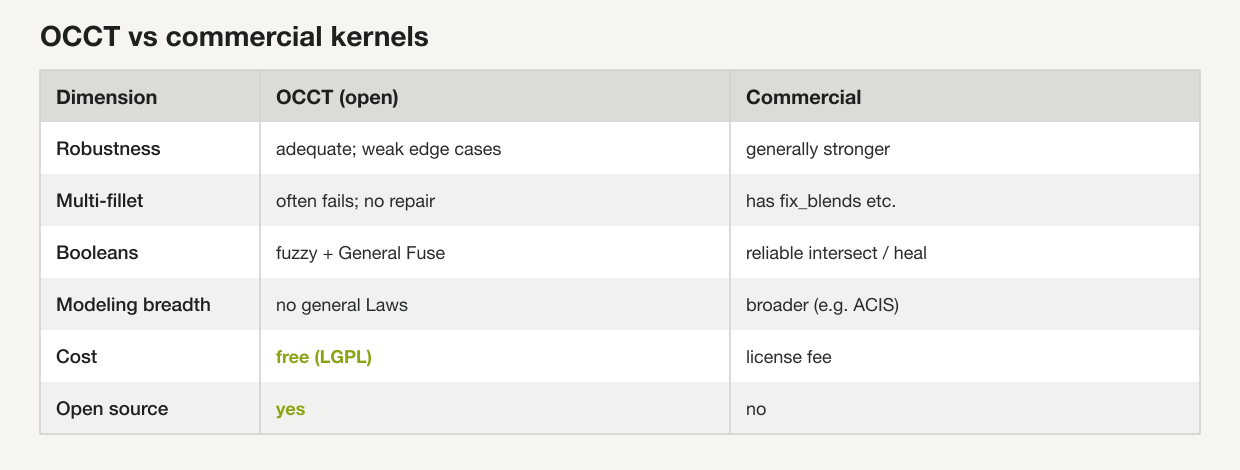
Figure 3: OCCT's main gaps and advantages versus commercial kernels. Drawn by CADFrontier.
5. Where it is headed, and my view
OCCT is developed by Open Cascade SAS, a subsidiary of Capgemini; at FOSDEM 2026 the OCCT3D team presented a roadmap in which the whole release is rebuilt around three themes — API stability, maintainability and usability — with the BRepGraph and collections overhaul laying groundwork for later algorithms. By the public milestones, 8.0.2 is due in October and 8.1 in January 2027; the company also offers commercial support and critical-bug-fix services.
My take: for AI×CAD, how robust the kernel is directly decides whether AI-generated geometry can enter a workflow. OCCT is catching up on modernization and robustness, but the edge cases in fillets and Booleans remain its main gap to commercial kernels — and the more AI produces, and the more automated it is, the more this gap matters, because the failure is usually not "it cannot build it" but the fillets and Booleans in harder cases: common parts are mostly fine, but once several fillets meet at a vertex, or a Boolean involves near-coincident inputs, those edge cases are where it tends to break. The Rust newcomers are worth watching, but production readiness is still some way off. For the short to medium term, OCCT remains the open-source kernel behind AI×CAD, and it is getting sturdier — which is both its strength and the precondition for the whole open-source CAD ecosystem to keep moving forward.
This article is an editorial analysis based on public material; the information follows official release notes and public repositories and was not compile-tested item by item. The illustrations are conceptual diagrams drawn by CADFrontier.
Sources & further reading
- OCCT 8.0.0 release notes (GitHub Discussion) ↗Source region: International
- OCCT Releases and Milestones (GitHub) ↗Source region: International
- FOSDEM 2026: OCCT3D 8.0 — Evolving the Open Source Geometry Kernel ↗Source region: International
- CAD International: why the geometry kernel matters ↗Source region: International
- CADShift: fillet failures and how kernels handle them ↗Source region: International
- Gensolid: an open-source B-Rep kernel benchmarked vs Parasolid (GitHub) ↗Source region: International
- Fornjot: an open-source CAD kernel in Rust (GitHub) ↗Source region: International